Church Raiding - Broken Families and the Shattered World
A woman of retirement age is brutally beaten by her husband.
It may seem not to relate to the religious conflict. The reason is simple: she has worked as a cashier of an Orthodox parish for many years and gained respect and enhanced her social status in the village due to distinguished service. Her voice is valid among the villagers. For one, she can refute the slanderous attacks on the priest, who is driven out of the church he ministers at- what could be easier for the raiders than to accuse the senior priest of theft? Now this woman is afraid to support her confessor. It is easy to talk about martyrdom, religious asceticism, opposing enemies of faith, if all this is happening to strangers. The woman has to live under the same roof with her husband, who is afraid of losing a share or a rented lake, and pours his fear out, beating the poor women. There is no support from the children either, and bruises for trying to save the church cash haven’t gone yet...
A daughter and her mother are not talking to each other.
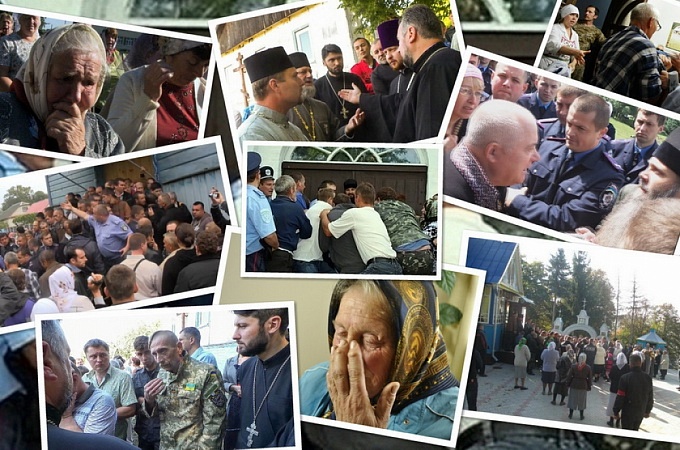
The situation doesn’t seem to be extraordinary as daughters often do not find the common language with their mothers. However, in this case the misunderstanding is deepened by church raiders of the UOC-KP. A heated interfaith conflict in a small western Ukrainian village led to a mass brawl and cruel militia bashing. The woman, who has raised three daughters, is hiding from his pursuers not at her children’s, but in the nearby monastery. Due to the lack of understanding of what is happening the daughter publicly blames the denomination, which the church and her mother belong to. However, the elderly woman, like the Church, has obviously become a victim of the conflict. Besides, the mother may need a support of her family in such hard times.
Divorce is the last point in a religious dispute.
Under normal circumstances, of course, the couple could not come to battered pots, and the husband and wife definitely have other differences, apart from religious views. However, in the dispute, which priest would baptize a newborn baby, the Orthodox side of the family has given way, and the child received the Greek Catholic baptism. The family started to ruin, and in the past tumultuous year it has largely resulted in religious misunderstanding. It made it final: the husband leaves the family, the child undergoes the optional Orthodox rite.
A senior woman is not allowed to attend an Orthodox church service.
Paradoxically, even in the family of the UOC-KP priest who descended to the seizure of a neighbouring church of the UOC, voices in defense of the Orthodox Church are raised. However, the job is done, the public is exposed to all sorts of "support and understanding", but the old woman, unwilling to take a split, is not allowed to attend an Orthodox church service. We may only assume how it all happens.
It’s difficult for agnostics and atheists to accept the phrase "God will punish you." But victims of religious conflicts and hostile takeovers in Ukrainian villages are very well remembered. Remembered are also those converts and patriotic believers who have written denunciations on their neighbours recently- for example, for bringing children to church. Remembered is what happens to a man when he goes against the Church of God.
A village head, taking a delegation of UOC believers, outraged with UOC-KP intrigues, says, crossing himself, that there won’t be their church in the village - and the next day his father dies. Too critical parishioner, who does not disdain gossip and says that she even can’t stand the look of the priest ... loses his sight. It could be explained by the law of probability. But only as long as it does not concern yourself.
Read also
The Council of Crete: a decade of unity in name only
Constantinople marked the anniversary of the Council of Crete with a theological conference in France. They spoke about the unity of Orthodoxy, although over the past years there has noticeably been less of it.
Yelensky’s plan: Why is DESS demanding what the UOC has already done?
DESS is demanding that the UOC take steps it has already taken, while offering no assurance that further demands will not follow. What is behind Yelensky’s ultimatum?
Why OCU hierarchy lacks canonical ordination: what Local Churches say
The OCU head refuses to address invalidity of his ordinations. But almost all Local Churches speak of it – even those that recognized the OCU.
Why nation-first advocates do not call for peace
Ukraine’s population is declining by nearly one million people a year, and experts are warning of the nation’s demographic extinction. Yet the leaders of the Orthodox Church of Ukraine (OCU) and the Ukrainian Greek Catholic Church (UGCC) continue to call for war and mobilization.
The deception that decided the fate of the Tomos
In 2008, the "Filaret problem" derailed Yushchenko's plan. In 2018, Poroshenko solved it in just one hour – with a police escort for the Greeks and verbal promises to Filaret.
Lawyers in the crosshairs: How UOC is being stripped of its right to defense
Activists harass UOC lawyers outside courthouses, call them “traitors” on air, and promise them a “warm welcome” at hearings. The Church’s right to a legal defense is at stake.