“Azov” nationalist party nests extremely brutal neo-pagans, – sectologist
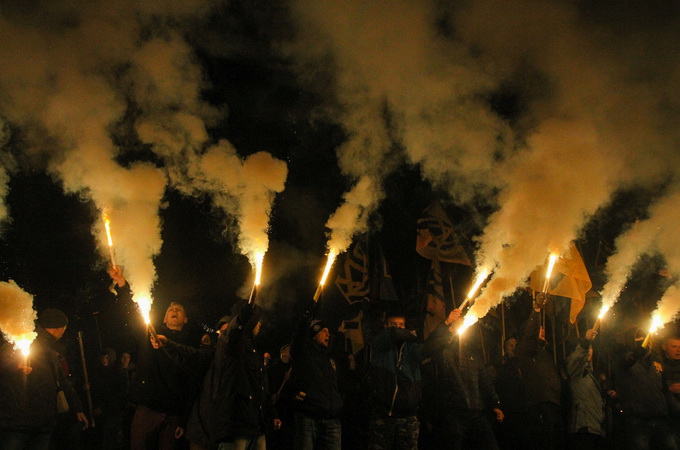
“Their ideology arises from pre-Christian nationalist traditions, rituals, customs and maxims. They are particularly atrocious and this attracts attention of new adepts from the youth environment,” says sect expert Vladimir Rogatin. According to him, 60% of “Azov” members are followers of pagan sects. Even an idol of Perun has been recently erected in Mariupol on the regiment territory.
An occult symbol of “Black Sun” (broken radial rays coming out of the black circle) is signed in “Azov” symbolics, tattooed on fighters’ bodies and those of the NC members, and was actively used by the Nazi Germany to communicate distinctive abilities to the “Nordic race”.
“A lot of our ‘native believers’ joined “Azov”, they fought together. “Azov” members also come round and take part in festivities of Perun and Kupala idols. Besides, neo-pagans participate in the NC party’s work on site, told magus Svitovit from Zaporozhye. – Personally, I do not become a party member, since I am a wizard, but I do not forbid anyone to do it.”
Party’s spokesman Alexandr Alferov told “Vesti” that pagan organizations are not prohibited in Ukraine and one cannot influence confession preferences of the party members: “We condemn only participation in marginal organizations.”
Read also
Ukraine’s Foreign Ministry plans advocacy visits abroad for UCCRO
Members of the All-Ukrainian Council of Churches and Religious Organizations have planned advocacy visits abroad following a meeting with Ukraine’s deputy foreign minister.
UOC priest detained by recruitment officers in Kyiv sent to training ground
UOC priest Maksym Kostiuchenko, who was detained on his way to a church service in Kyiv, has been sent to a military training ground in Chernihiv Region.
25 tons of humanitarian aid from Volyn reach Sviatohirsk Lavra
Around 25 tons of food donated by believers of the UOC Volyn Eparchy arrived at Sviatohirsk Lavra on October 22.
UOC West European Vicariate holds children's camp in Germany
A children’s camp was held in the UOC’s Western Deanery in Germany from October 19 to 23.
Vinnytsia Metropolitan consecrates UOC Intercession church in Luka-Barska
Metropolitan Varsonofy consecrated the Church of the Intercession in Luka Barska, Vinnytsia Region, and celebrated the first Divine Liturgy in the new church.
“Joy of All Who Sorrow” lower сhurch сonsecrated in Korosten
Metropolitan Nikodim of Zhytomyr and Novohrad-Volynskyi presided over the consecration of the church and celebrated the Divine Liturgy at St. Nicholas Church in Korosten.