Scientists publish new findings on the Shroud of Turin
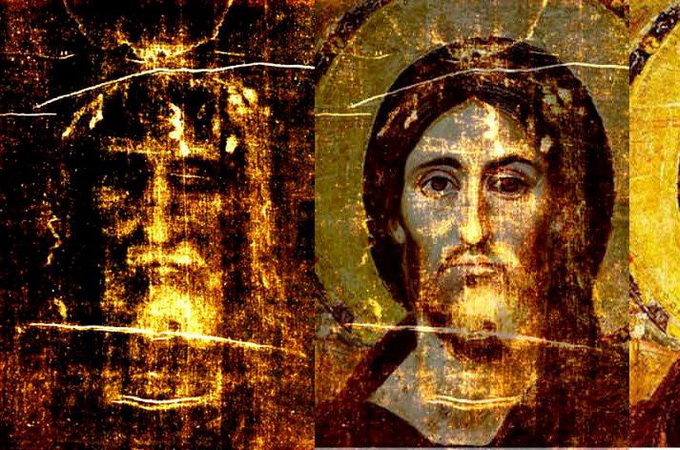
The Shroud of Turin. Photo: open sources
In an article published in the Italian newspaper La Stampa, Andrea Tornielli presented new scientific findings on the famous Shroud of Turin – the linen cloth that, according to Christian tradition, was used to wrap the body of Jesus Christ after His crucifixion.
The study revealed that the Shroud contains traces of human blood from a man who suffered numerous severe injuries before death, Sedmitza reports.
The results were obtained through the analysis of fabric fibers taken from the foot area of the Shroud. The research was conducted by two institutions: the Istituto Officina dei Materiali (IOM-CNR) in Trieste and the Institute of Crystallography (IC-CNR) in Bari, in collaboration with the Department of Industrial Engineering at the University of Padua. The study was published in the American journal PLOS ONE under the title: "New Biological Evidence from Atomic Resolution Studies on the Turin Shroud."
The research showed that the Shroud’s fibers are completely covered with nanoparticles of creatinine bound to particles of ferrihydrite – a combination not typical of the blood serum of a healthy human being. High levels of creatinine and ferritin in blood are associated with the trauma and suffering caused by severe injury, including torture.
“The presence of these biological nanoparticles discovered during the experiments points to the violent death of the man who was wrapped in the Shroud of Turin,” concluded Professor Giulio Fanti of the University of Padua, who participated in the study of the relic.
Elvio Carlino of the Institute of Crystallography in Bari, who led the new research, noted: “The nanoparticles attached to the linen fibers recorded a scenario of intense suffering endured by the victim who was then wrapped in the burial cloth. These results could only be detected using methods recently developed in the field of electron microscopy.”
The results of this new study, carried out by prestigious Italian research centers, are highly significant and fully confirm the hypothesis put forward during earlier studies by biochemist Alan Adler in the 1990s.
There is now no doubt that the Shroud was used to wrap the body of a man who was tortured and killed in a manner exactly as described in the Gospels' account of the crucifixion of Jesus Christ.
Read our materials on the UOJ's Telegram channel.
Read also
Volodymyr-Volynskyi Eparchy marks 30 years since restoration
The Pantanassa Icon and relics of Prince Volodymyr have arrived in Kovel and will visit churches across the Volodymyr-Volynskyi Eparchy to mark the 30th anniversary of the restoration of the episcopal see.
Bukovyna faithful bring humanitarian aid to Kherson region residents
The UOC’s Chernivtsi Eparchy delivered food to Holy Spirit Cathedral in Kherson.
Ukraine must have its own faith: Poroshenko's party lays out peace terms
Poroshenko’s party European Solidarity described church policy as a matter of national sovereignty and said there can be no compromises in this area.
432 UOC churches damaged in Ukraine during war, report says
According to the Religion on Fire project, 807 religious buildings in Ukraine have been damaged or destroyed as a result of hostilities.
DESS official gives number of clergy exempt from mobilization in Ukraine
A DESS representative said the actual number of clergy exempt from mobilization is significantly lower than the number of religious organizations designated as critical.
Cabinet keeps gas prices unchanged for religious organizations
The Cabinet has fixed gas prices for religious organizations through the end of the 2026–2027 heating season.