Seizures of temples. How it was: Khodosy
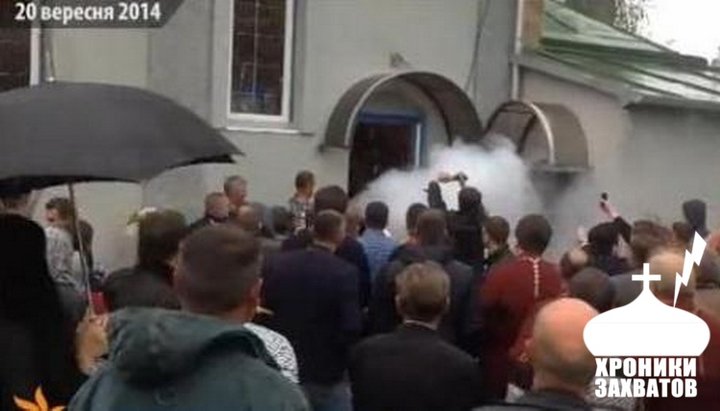
On September 20, 2014, the "Right Sector" and schismatics broke the doors, tied the watchman and seized the temple of the UOC
The interfaith conflict in the village of Khodosy of the Rovno district, the Rovno region, was the beginning of a number of raider attacks in the local eparchy of the UOC. this time, the chief initiator of a bad fight at the church cemetery and in the church was a high-ranking official, the head of the Rovno State Administration Alexei Buchinsky, who is the head of the local branch of the nationalist party "Svoboda". Actually, Mr. Buchinsky directed and took an active part in cutting the locks of the church of Khodosy and beating believers of the UOC.
On September 20, 2014 at 16:00, on the eve of the Nativity of the Virgin, a festive evening service began in the Khodosy church, which was attended by the clergy of the Rovno eparchy of the UOC. At 16:15, supporters of the UOC KP, including a lot of non-local people, started gathering near the temple. The schismatics held a meeting and decided to transfer the church to a newly registered community of the UOC KP. The meeting lasted less than 20 minutes. It was not attended by the believers of the UOC, because at that moment they were praying in the temple.
"At the end of the meeting, supporters of the UOC KP, together with radicals from the parties 'Svoboda' and the 'Right Sector' began the raider seizure of the temple," recalls Protopriest Valery Kapitaniuk, the dean of the Rovno deanery. "During the service, they went to church, kicked out the laymen and part of the clergy of the UOC, although several priests managed to close the temple from the inside and continue the service of God."
"Then the radicals did not stop, they brought a generator, a grinder, metal clubs and rebars brought in advance," recalls priest Andrei Tizhuk, the rector of the church in the village of Khodosy. "Armed supporters of the Kiev Patriarchate began to saw the door. My parishioners, who tried to prevent them from entering the temple from the outside, were beaten with metal clubs and feet. In the fight for the church, not only the laity, but even the dean of the Rovno deanery of the UOC Valery Kapitaniuk suffered, having his cassock torn and the priestly cross snatched off."
When the schismatics managed to enter the church, they immediately served a thanksgiving service for the "voluntary" transition of another parish to the bosom of the "patriotic" UOC KP.
It is worth noting that the militia and SBU officers, passively watching the developments, turned a deaf ear to all requests of the UOC believers for help.
After the raider seizure of the church by the schismatics, the believers of the UOC began constructing a temple, and a year ago they served the first Divine service in the new, but still unfinished church.
"Thank God, the Lord did not leave the faithful of the Ukrainian Orthodox Church," says Father Andrei, "we have a new small church. Of course, people in the village were divided into two camps and at first even were at enmity with one another, but time heals any wounds, things are better now. My parishioners are mostly those who went to church every Sunday, who can pray, knows how to forgive, to love and is faithful to the Orthodox tradition."
Read also
Pentarchy with Rome: A return to the roots or a new schism?
Patriarch Bartholomew wants to revive a council of five patriarchates, including Rome. What would reunion with Catholics look like, and what role would be left for the other Churches?
Concubine or daughter? On words that cannot be used about the Church
An archon of the Church of Constantinople likened the UOC to Moscow’s “concubine.” But for St. Epiphanius of Cyprus, “concubines” are heresies.
Shameful chronicle of one week: how the OCU was born
Exarchs under escort, a call from the operations room, and 36 votes for Epifaniy: what a member of the Phanar delegation revealed about the 2018 "Council".
Can UOC eparchies be dissolved before court ruling on Metropolia?
DESS is launching separate proceedings against UOC eparchies, monasteries, and institutions while the case involving the Kyiv Metropolia is still pending.
Two murders, one silence
Zelensky condemned the killing of a Catholic priest in Poland the very same day. A month earlier, a UOC monk was murdered at the Sviatohirsk Lavra – and the president has remained silent ever since.
A bow to Phanar? Why did UOC academy congratulate Constantinople’s exarch?
A delegation from the Kyiv Theological Academy congratulated the Phanar’s exarch, who has remained silent about the persecution of the UOC. Who authorized this gesture, and why did even OCU supporters fail to appreciate it?