Seizures of temples. How it was: Rachin
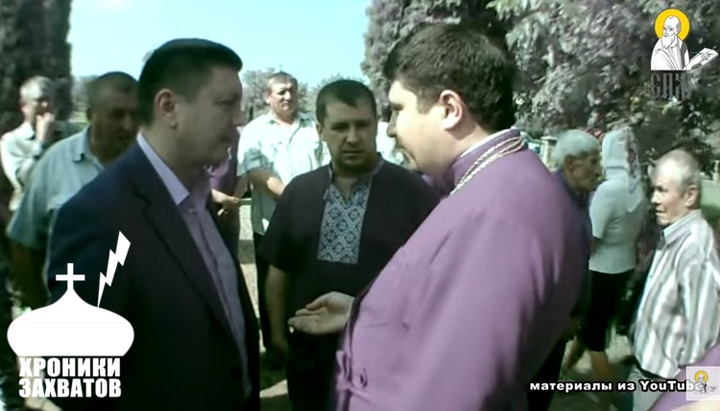
On September 1, 2014, national radicals from the Right Sector came to the temple, tore off the door locks, and broke into the church in the presence of law enforcement officers
An inter-confessional conflict in the village of Rachin, Dubno district, began with an unauthorized referendum in a rural club. On August 31, 2015, a vote was taken on whether the villagers belonged to the Moscow or Kiev Church (this was how the question put to the vote was worded), events in the club were filmed and uploaded on the Internet. Deputy of the village council Victor Belous, head of the school Aleksandr Tkachuk, representative of the public council of Dubno Regional State Administration Vladimir Krokmal were invited to the place as observers. The total number of inhabitants of the village is 1419 people, who ostensibly voted for the "Kiev" church by a majority.
After the referendum was held, Protopriest Andrei Dekar, rector of the Kazan parish, gathered the parishioners for a prayer service near the church, because local activists had taken away the keys from the shrine.
"We were praying, the people near me were as many as on a regular Sunday at the service," recalls protopriest Andrei Dekar. “As soon as the moleben was over, local supporters of the UOC-KP arrived together with the village chairman (after all these events the head of the village could not stand inter-confessional quarrels and left the post) and initiated the sealing of the church, voicing the results of the voting. The police officers together with the head of the Dubno inter-district department of the Ministry of Internal Affairs of Rovno region, present at the scene, did not prevent this decision and allowed it to be carried out, although by law such actions require the permission of the prosecutor."
A few days later, representatives of the UOC-KP came threatening the rector, so that he quietly and calmly gave all the documents to the church, but the father refused. Then on September 1, 2014, radical nationalists from the Right Sector came to the temple, tore down the locks and broke into the church in the presence of law enforcement. Subsequently, the head of the Dubno district police department handed the keys to the church to the schismatics.
According to the application filed by the religious community of the UOC, no proceedings were instituted, as law enforcement agencies do not see any corpus delicti in the actions of the representatives of the Kyiv Patriarchate.
Believers of the UOC, deprived of their own church, began to conduct divine services in the chapel at the local cemetery, without entering into conflict with their fellow villagers.
"One of my parishioners donated the land to the church, although she herself does not have large incomes," Father Andrei says. “When the schismatics learned that we would be building a new temple, they began to undertake various attempts to stand in our way: they brought the "Cossack Watch" from Dubno and they blocked the road, we were not allowed to go to work, the village council put a spoke in our wheel and did not agree on the documents, the officials arranged inspections, but God's Will let the temple be."
On December 17, 2016, the foundation of a new church was consecrated in the village in honor of St. Barbara the Great Martyr. Now the church is shining with domes and rough work is being done inside. The religious community of the UOC of Rachin village plans to hold the first divine service in the built church in the autumn.
Read also
The deception that decided the fate of the Tomos
In 2008, the "Filaret problem" derailed Yushchenko's plan. In 2018, Poroshenko solved it in just one hour – with a police escort for the Greeks and verbal promises to Filaret.
Lawyers in the crosshairs: How UOC is being stripped of its right to defense
Activists harass UOC lawyers outside courthouses, call them “traitors” on air, and promise them a “warm welcome” at hearings. The Church’s right to a legal defense is at stake.
How to respond to persecution: Lessons from St. Silouan the Athonite
The Church can and should be defended, but without malice. Why love for persecutors is not weakness but the only way to preserve the Spirit of Christ in the midst of the struggle.
Where the Spirit of the Lord is, there is freedom
Reflections on the controversies surrounding the creation of the OCU.
Pentarchy with Rome: A return to the roots or a new schism?
Patriarch Bartholomew wants to revive a council of five patriarchates, including Rome. What would reunion with Catholics look like, and what role would be left for the other Churches?
Concubine or daughter? On words that cannot be used about the Church
An archon of the Church of Constantinople likened the UOC to Moscow’s “concubine.” But for St. Epiphanius of Cyprus, “concubines” are heresies.