Christ-centered vs hate-centered
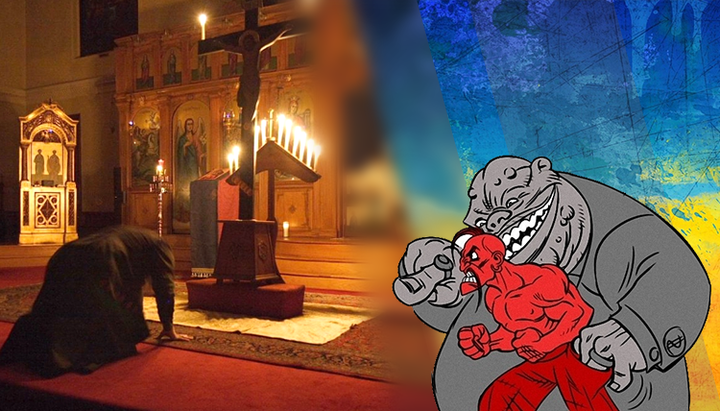
The supporters of the autocephalous project themselves do not pretend to hide that the motives behind it are not purely religious, but purely political. As Poroshenko said, "this is a matter of independence and national security." Therefore, it is all about subordinating the life of the Church to the demands of non-practicing or non-believing people whose considerations are pinned on what has nothing to do with the mission of the Church of Christ in this world.
These considerations may be clear or not, make one agree or protest, but in any case they remain purely political, purely secular, tied to the current interests of specific individuals and ongoing conflicts. This raises a fundamental question of whether the Church should obey the world and whether people can externally dictate to the Church in terms of Her life and organization.
It is a question of what the Church is and what is its mission in the world.
The above question does not seem relevant to secular people: the Church is just one of the public organizations whose influence should be used to achieve some secular goals. All the talk about God, about eternal salvation, about the right faith is incomprehensible, sometimes directly denied, sometimes falling on deaf ears of a secular man. "The Single Local Church" is needed not for the sake of saving souls, but for the sake of, as Oleg Tiagnibok said, "cheap sausage."
How church reorganization can affect sausage prices is a mystery. Anyway, a fundamental discrepancy between the supporters and opponents of the current autocephalous project consists in what the Church exists for in general. From the point of view of autocephalists (this point of view being continually reiterated) – for the sake of geopolitical interests, for the sake of state unity, for the sake of rebuffing enemies, for the sake of cheap sausage. From the point of view of those who take this project quite discreetly – for the sake of serving God and saving souls.
The current dispute, therefore, is a dispute not about whether autocephaly as such is acceptable or not. It is about who basically determines the mission of the Church and who has the right to resolve the issues of its internal structure – the Church itself, arising from its faith and dogmata, or external politicians, arising from their political goals.
Moreover, the political project behind autocephaly is built on principles that are difficult to reconcile with the principles of the life of the Church. If to express the discrepancy with one phrase, then this project is hate-centered, whereas the Church is Christ-centered.
The political project behind autocephaly is built on principles that are difficult to reconcile with the principles of the life of the Church. If to express the discrepancy with one phrase, then this project is hate-centered, whereas the Church is Christ-centered.
The Church is an association "around" – politics is an association "against".
The Church unites people around Christ – politicians unite them against the enemies.
The Church testifies about God, Who wants all people to be saved and to come to know the truth – politicians shout "death to the enemies!".
The Church brings people together regardless of their native (or preferred) language or political likes – politicians never stop looking for new reasons for separation and enmity.
The nationalistic project is built on repulsion – and this, in its own way, is natural. The simplest and quickest way to form a community is to mobilize it against a common enemy. "We are against them" is a cheap and effective way of creating this "we". Just like one can constantly hear from nationalists, "the war shapes the nation".
The weakness of this approach is that the existing unity turns out to be very fragile – or even completely illusory, for a number of reasons, out of which we will pay attention to one here.
Such a social project cannot be managed only by external enemies – it inevitably needs internal enemies and traitors. Fighting against enemies does not improve people's lives at all – and this should be somehow explained, or at least, one should distract people from this rude fact. In 1937, the Soviet authorities needed to somehow explain the failure in socialist building. Of course, it could not be explained by the errors of the party leadership, or, especially, by the fallaciousness of the ideology itself. Therefore, all the failures were attributed to the activity of spies and wreckers, who spitefully envied the happiness of the Soviet people and put different spokes in the Soviet wheel.
Fighting against enemies does not improve people's lives at all – and this should be somehow explained, or at least, one should distract people from this rude fact.
The nationalistic project faces the same problem – people's lives have not improved after the Maidan – and resolves it identically, seeking to redirect all issues to enemies and traitors, who must be discovered for this end. Or even created – from the people who by themselves did not at all want to be in conflict.
Therefore, enemy-hunters, proclaiming the unity of the nation, in fact inevitably destroy it, creating internal conflicts literally from nothing.
State interests would require the maintenance of peace in the religious sphere – but the interests of nationalism as a movement require enmity and strife wherever possible. Wherever the Church sees its flock, people precious to God and called to eternal salvation, nationalism sees enemies and traitors whom they want to pick up on knives and hang on a branch. Where the Church seeks reconciliation, nationalism ravens exclusively on hatred.
Alas, in this atmosphere, autocephaly would mean an attempt to subordinate the Church to a nationalistic, hate-centered project, in which instead of "Christ is risen from the dead, so we have to forgive all those who hate us", "death to the enemies" is proclaimed.
Will Patriarch Bartholomew give in to the temptation for the sake of personal valorization to play up to the nationalists? We do not know and we must hope for the best. Anyway, bestowal of the Tomos to the nationalists will not make them a Church – especially given that the people who demand it, for the most part, do not care about religion. Furthermore, it will not help the unity of Ukrainian believers because the people who ask for it do not seek this unity but look for enemies.
However, no matter how events might unfold, one should pray that the canonical Ukrainian Orthodox Church, headed by Metropolitan Onufry, retains that peaceful and meek spirit that distinguishes it so distinctly from its fierce opponents. To the cries of "death!" the Church responds "Choose life, so that thou and thy seed may live" (Deut. 30:19).
Read also
The Council of Crete: a decade of unity in name only
Constantinople marked the anniversary of the Council of Crete with a theological conference in France. They spoke about the unity of Orthodoxy, although over the past years there has noticeably been less of it.
Yelensky’s plan: Why is DESS demanding what the UOC has already done?
DESS is demanding that the UOC take steps it has already taken, while offering no assurance that further demands will not follow. What is behind Yelensky’s ultimatum?
Why OCU hierarchy lacks canonical ordination: what Local Churches say
The OCU head refuses to address invalidity of his ordinations. But almost all Local Churches speak of it – even those that recognized the OCU.
Why nation-first advocates do not call for peace
Ukraine’s population is declining by nearly one million people a year, and experts are warning of the nation’s demographic extinction. Yet the leaders of the Orthodox Church of Ukraine (OCU) and the Ukrainian Greek Catholic Church (UGCC) continue to call for war and mobilization.
The deception that decided the fate of the Tomos
In 2008, the "Filaret problem" derailed Yushchenko's plan. In 2018, Poroshenko solved it in just one hour – with a police escort for the Greeks and verbal promises to Filaret.
Lawyers in the crosshairs: How UOC is being stripped of its right to defense
Activists harass UOC lawyers outside courthouses, call them “traitors” on air, and promise them a “warm welcome” at hearings. The Church’s right to a legal defense is at stake.