Seizures of temples. How it was: Duliby
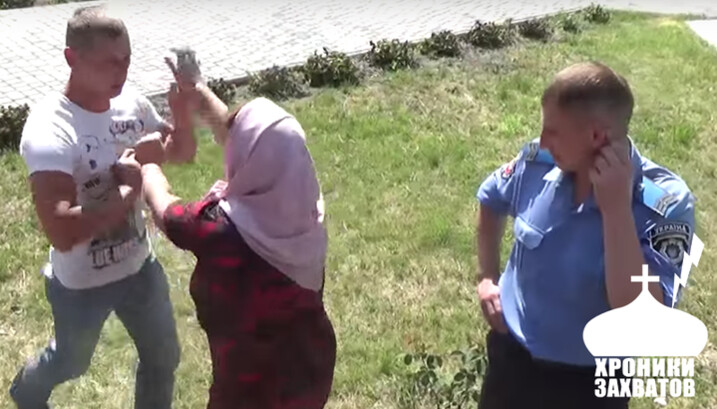
Conflict during the seizure of the UOC temple in the village of Duliby
In June 2015, the UOC religious community of Duliby was discriminated against by the chairman of the Duliby village council Mironchuk Lesia Alekseyevna, who unlawfully seized official documents of the UOC community with the purpose of further transferring the temple to another entity – the Kiev Patriarchate.
The official motivated discriminatory actions by the fact that she as the head of the territorial community is supposed to decide who is allowed to dispose of the rural church building.
"Lesia Mironchuk is a sister of the dean of the Goshcha district of the UOC-KP," said Protopriest Sergei Timofeev, the rector of the church in the village of Duliby. "This woman, instigated by her brother, began an inter-faith war in the village. Duliby is a very small village, the population is calm and balanced, mostly older people. Young people abandon it because it is too remote from the district centre. The only centre of culture and spirituality is the church. Why did they trample it into the mud, sow discord, aggression and human strife?"
On July 7, 2015, at a meeting of the territorial community, the chairman of the Duliby village council, in support of its illegal actions against the community of the UOC, publicly announced the transfer of documents and the temple to another religious community - the Kiev Patriarchate, which subsequently led to the incitement of inter-faith strife among the local population.
"Mrs Lesia humiliated our rector at the meeting, calling him a Moscow servant," says Taras, a local resident. "She openly lied that the priest calls Putin's army to Ukraine in his prayers. It's good that among the Dulibovites there are adequate, thinking people who stopped these talks and did not support the slanderer."
Unable to convince all the villagers, right after the meeting the newly formed religious community of the Kiev Patriarchate illegally registered at the address of the disputed church. The church of the Most Holy Theotokos was judicially returned to the ownership of the UOC believers.
However, the inter-faith conflict in Duliby did not end there: a new aggravation occurred on June 26, 2016, when the schismatics-samosviaty tried to take away the Orthodox church, breaking into it at the beginning of the divine service. Anatoly Mironchuk, the dean of the Goshcha district of the UOC-Kiev Patriarchate, led the assault, along with his wife, as well as his sister Lesia Mironchuk, who was a former village head.
Read also
Why nation-first advocates do not call for peace
Ukraine’s population is declining by nearly one million people a year, and experts are warning of the nation’s demographic extinction. Yet the leaders of the Orthodox Church of Ukraine (OCU) and the Ukrainian Greek Catholic Church (UGCC) continue to call for war and mobilization.
The deception that decided the fate of the Tomos
In 2008, the "Filaret problem" derailed Yushchenko's plan. In 2018, Poroshenko solved it in just one hour – with a police escort for the Greeks and verbal promises to Filaret.
Lawyers in the crosshairs: How UOC is being stripped of its right to defense
Activists harass UOC lawyers outside courthouses, call them “traitors” on air, and promise them a “warm welcome” at hearings. The Church’s right to a legal defense is at stake.
How to respond to persecution: Lessons from St. Silouan the Athonite
The Church can and should be defended, but without malice. Why love for persecutors is not weakness but the only way to preserve the Spirit of Christ in the midst of the struggle.
Where the Spirit of the Lord is, there is freedom
Reflections on the controversies surrounding the creation of the OCU.
Pentarchy with Rome: A return to the roots or a new schism?
Patriarch Bartholomew wants to revive a council of five patriarchates, including Rome. What would reunion with Catholics look like, and what role would be left for the other Churches?