Session of the UOC Bishops’ Council is held at Kiev-Pechersk Lavra
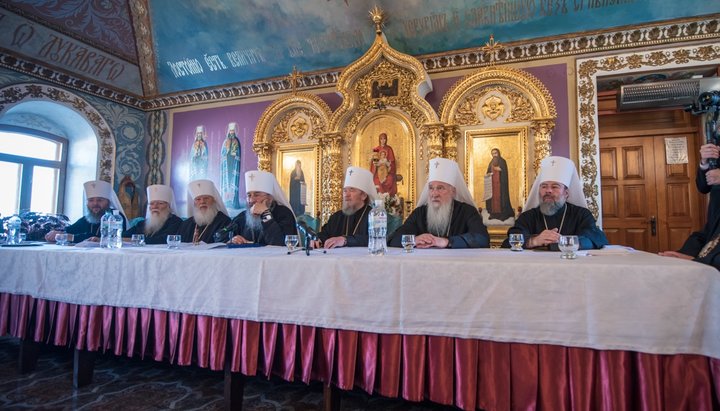
Session of the Bishops' Council of the UOC
On 13 November 2018, the meeting of the Council of Bishops of the Ukrainian Orthodox Church, chaired by His Beatitude, Metropolitan Onufriy, continues at the Kiev-Pechersk Lavra. This is reported by the Information and Education resource of the UOC.
Out of the 90 diocesan and vicar bishops who have the right to vote, 83 bishops arrived at the monastery. According to the Statute of the UOC, a quorum is made of 2/3 of its members, i.e. 56 bishops. Thus, the Council is held with the quorum provided.
As it became known, Petro Poroshenko refused to come to the Kiev-Pechersk Lavra to meet with the bishops of the Ukrainian Orthodox Church. A provocation was being prepared against the hierarchs of the UOC — after an agreement had been reached on the appointed date, the bishops received an order from the head of the Presidential Administration, Igor Rainin, to arrive at the same time (2.00 pm) at the Ukrainian House.
At 11:00 a session of the Holy Synod of the UOC began at the Kiev-Pechersk Lavra.
Read also
Volodymyr-Volynskyi Eparchy marks 30 years since restoration
The Pantanassa Icon and relics of Prince Volodymyr have arrived in Kovel and will visit churches across the Volodymyr-Volynskyi Eparchy to mark the 30th anniversary of the restoration of the episcopal see.
Bukovyna faithful bring humanitarian aid to Kherson region residents
The UOC’s Chernivtsi Eparchy delivered food to Holy Spirit Cathedral in Kherson.
Ukraine must have its own faith: Poroshenko's party lays out peace terms
Poroshenko’s party European Solidarity described church policy as a matter of national sovereignty and said there can be no compromises in this area.
432 UOC churches damaged in Ukraine during war, report says
According to the Religion on Fire project, 807 religious buildings in Ukraine have been damaged or destroyed as a result of hostilities.
DESS official gives number of clergy exempt from mobilization in Ukraine
A DESS representative said the actual number of clergy exempt from mobilization is significantly lower than the number of religious organizations designated as critical.
Cabinet keeps gas prices unchanged for religious organizations
The Cabinet has fixed gas prices for religious organizations through the end of the 2026–2027 heating season.