Lawyer: The law on renaming the Church impedes Eurointegration of Ukraine
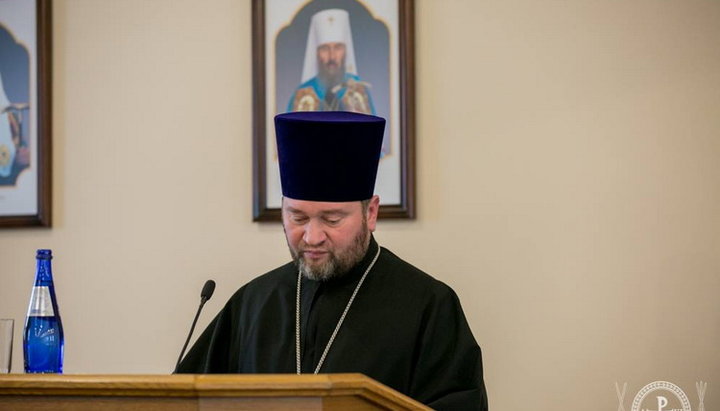
Chairman of the Law Department of Borispol eparchy of the UOC Protopriest Alexei Nosenko
The law adopted by the Verkhovna Rada on renaming the Church (former bill No. 5309) violates not only the Constitution and the laws of Ukraine, but also the norms of international law, says Protopriest Alexei Nosenko, head of the Law Department of Borispol eparchy of the UOC.
First of all, Article 35 of the Constitution is violated – that everyone has the right to freedom of religion or belief, the UOC Information and Education Department reports his words.
There are violations of international law:
- Art. 18 of the Universal Declaration of Human Rights of December 10, 1948, which enshrines that “everyone has the right to freedom of thought, conscience and religion; this right includes freedom to change his religion or belief, and freedom, either alone or in community with others and in public or private, to manifest his religion or belief in teaching, practice, worship and observance.”
- Art. 9 of Section 1 of the Convention for the Protection of Human Rights and Fundamental Freedoms of November 4, 1950, according to which “everyone has the right to freedom of thought, conscience and religion; this right includes freedom to change his religion or belief, and freedom, either alone or in community with others and in public or private, to manifest his religion or belief in teaching, practice, worship and observance.”
- Art. 14 of Section 1 of the same Convention says that “the enjoyment of the rights and freedoms set forth in this Convention shall be secured without discrimination on any ground such as sex, race, colour, language, religion, political or other opinion, national or social origin, association with a national minority, property, birth or other status.”
“The aforementioned violations of the Constitution and the norms of international (European) law are all the more incomprehensible, since the state of Ukraine has taken a course towards European integration,” the head of the Legal Department notes.
He recalls that in its aspiration to Europe, Ukraine declared the compliance with EU values: democracy, respect for human rights and fundamental freedoms, and the rule of law.
“Therefore, the course towards the European integration of our state is not only a sequence of actions regarding Ukraine’s accession to the EU, but above all it’s a course on respecting European values, among which freedom of conscience and religion occupies one of the most important places,” emphasizes Prpr. Alexei.
Earlier, 49 deputies demanded that the Constitutional Court evaluate the anti-church law No. 2662 on renaming religious organizations from the point of view of the Constitution. Later, Minister of Justice Pavel Petrenko stated that this appeal is not a reason for non-execution of the law.
Read also
OCU activist admits breaking into UOC church in Sloviansk
Oleksandr Onyshchenko said that the OCU held its first "service" at the Seraphim Church, which had previously been broken into by forcing the locks and doors.
Archimandrite Ioustinos, longtime keeper of Jacob's Well, dies in Jordan
Archimandrite Ioustinos (Mamallos), the keeper of Jacob's Well in Nablus, has died after a prolonged illness.
Pilgrim group from Kyiv Theological Seminary visits Mount Athos
KTS students are making a pilgrimage to the holy sites of Romania, Greece, Mount Athos and Italy.
UOC cathedral celebrates its patronal feast in Ternopil
The service in the cathedral of the Holy Martyrs Faith, Hope, Love and their mother Sophia was led by Metropolitan Serhii of Ternopil, concelebrated by four hierarchs.
MinCulture marks centenary of Soviet-era reserve at Lavra's Refectory Church
Representatives of the Ministry of Culture presented awards to the Reserve's employees on the occasion of the anniversary at the Refectory Church of the Lavra.
Conference to mark 1700th anniversary of Christianity adoption held in Georgia
In Georgia, representatives of the Church and the state noted the defining role of Christianity in the country's cultural development.