Romanian Church asks Phanar to spell out the legitimacy of OCU ordinations
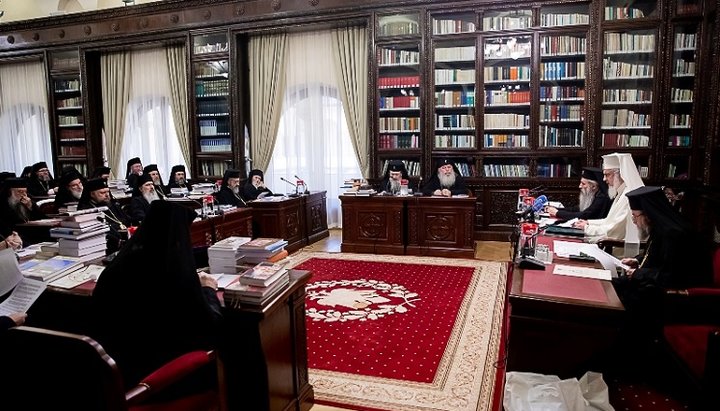
The session of the Holy Synod of the Romanian Orthodox Church
At the meeting of the Holy Synod, which took place on February 21, 2019, the Romanian Orthodox Church outlined a number of conditions necessary to determine its official position regarding the ecclesiastic situation in Ukraine. This is reported by the Greek portal Romfea.
“For almost 30 years, the problem of the split in Ukraine has not been solved, and there has not even been a call for pan-Orthodox mediation, as was the case with a split in Bulgaria,” the Synod said. “The Ecumenical Patriarchate, recognizing this impasse in resolving the situation, granted the Tomos on autocephaly to hierarchs, clergymen and believers who were in schism vis-à-vis the Russian Orthodox Church and all Orthodoxy, but this Tomos was accepted only by those from the Ukrainian Orthodox who were not in communion with the Moscow Patriarchate.
The Synod of the Romanian Church stated that as a result, “the problem of church unity in Ukraine is not resolved, including because there exists a large Russian ethnic population, which maintains a direct connection with the Moscow Patriarchate.”
Regarding its position in relation to the ecclesiastic situation in Ukraine, the Romanian Church explained that it reiterates the previously expressed point of view, which was voiced at meetings of the Holy Synod on May 24 and October 25, 2018.
The statement also emphasizes that the Romanian Patriarchate proposes to resolve the existing dispute through a dialogue between the Ecumenical and Moscow Patriarchs, which would result in a workable solution through maintaining the unity of the faith, respect for the administrative and pastoral freedom of the clergy and believers in this country, and restoring Eucharistic communion.
“If a bilateral dialogue is not crowned with success, it is necessary to convene a meeting of the Primates of the Orthodox Churches to solve the existing problem,” the Romanian Church said.
In addition, the Synod said that when making a specific decision on the Ukrainian church issue, first of all, it would take into account the fact that there are 127 Romanian parishes, mainly in Northern Bukovina, which are under the authority of the UOC. In this regard, the Romanian hierarchs noted the need to seek written guarantees from the church and political authorities of the Ukrainian state that the ethnic and linguistic identity of the Romanians be respected, and that Romanian believers have an opportunity to unite into the Romanian Orthodox vicariate and develop spiritual ties with the Romanian Patriarchate.
The Romanian Patriarchate also announced it would ask the Ecumenical Patriarchate to clarify the problem of non-canonical hierarchs and priests who belonged to the Kiev Patriarchate.
It is noted that the Holy Synod of the Romanian Orthodox Church will make a statement of its official position on the situation of Orthodoxy in Ukraine only after all the above-mentioned consultations have been made.
As the UOJ reported, earlier the Holy Synod of the Cyprus Orthodox Church stated that it would not recognize the OCU in its current status. The reason for this is the invalidity of priestly and episcopal ordinations in the OCU and the lack of church unity in Ukraine.
Read also
Pilgrim group from Kyiv Theological Seminary visits Mount Athos
KTS students are making a pilgrimage to the holy sites of Romania, Greece, Mount Athos and Italy.
UOC cathedral celebrates its patronal feast in Ternopil
The service in the cathedral of the Holy Martyrs Faith, Hope, Love and their mother Sophia was led by Metropolitan Serhii of Ternopil, concelebrated by four hierarchs.
MinCulture marks centenary of Soviet-era reserve at Lavra's Refectory Church
Representatives of the Ministry of Culture presented awards to the Reserve's employees on the occasion of the anniversary at the Refectory Church of the Lavra.
Conference to mark 1700th anniversary of Christianity adoption held in Georgia
In Georgia, representatives of the Church and the state noted the defining role of Christianity in the country's cultural development.
MP urges to ease pressure on UOC for sake of peace
Oleksii Honcharenko proposed compromises on language, historical memory, and Church issues as part of efforts to achieve peace, saying those who wish to attend the “Russian Church” should be allowed to do so.
Court takes 17th-century church in Staryi Pochaiv from UOC community
A commercial court overturned a 2018 registrar’s decision and stripped the UOC’s Ternopil Eparchy of ownership of the 17th-century church.