Met. Hilarion: Phanar’s ecclesiology fails to comply with Orthodox doctrine
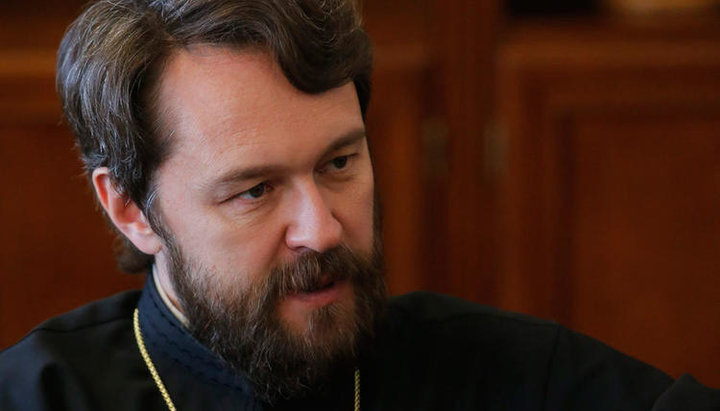
Metropolitan Hilarion (Alfeyev) of Volokolamsk
Over the past century, the Patriarchate of Constantinople has been trying to implement a new ecclesiological model, which provides for the exclusive authority of the Primate of the Church of Constantinople, which does not correspond to Orthodox teaching. The chairman of the Moscow Patriarchate’s Department for External Church Relations, Metropolitan Hilarion of Volokolamsk (Alfeyev), said this on Wednesday, February 27, at the presentation of the book “Constantinople and Russian Churches in the Period of Great Upheavals (1910s – 1950s),” reports TASS.
“Protecting its canonical borders and its unity, the Russian Orthodox Church considers it its duty to testify about the incompatibility of the Orthodox doctrine with the new ecclesiological model, which provides for the exclusive authority of the head of the first diptych of the Church,” said the Metropolitan. “The implementation of the scenario of the Ukrainian autocephaly is one of the key stages of imposing this model on the fullness of Orthodoxy. I am convinced that a correct vision of what happened is possible only with the account of all the elements of the agenda having been implemented by Constantinople for the past 100 years.”
According to Metropolitan Hilarion, the actions of the Patriarchate of Constantinople over the past 100 years can hardly be called friendly.
“The Patriarchate of Constantinople supported the renovationist split inspired by the Soviet authorities in the 1920s and 1930s. It non-canonically extended its jurisdiction to Estonia, Latvia and Finland, proclaimed the autocephaly of the Polish Church, which until then had been part of the Russian Church ...> Our Church had long preferred to keep silent about these sad phenomena of the past, trying to cover the spiritual mistakes committed by our brothers while trying not to change the historical truth and to be faithful to the holy canons,” the DECR head stated.
The author of the work “Constantinople and Russian Churches in the Period of Great Upheavals (1910s - 1950s)” is Mikhail Shkarovsky, professor of the general ecclesiastic postgraduate and doctoral schools and of St. Petersburg Theological Academy. The presentation of the book was attended by representatives of the Antioch, Bulgarian Churches, as well as the Orthodox Church of the Czech Lands and Slovakia.
As the UOJ reported, earlier Metropolitan Hilarion of Volokolamsk declared that the participants in the “unification council”, which was held in Kiev on December 15, would be erased from the historical memory of the Church.
Read also
Medieval сhurch сrumbles as Culture Ministry сites missing agreement
The 14th–15th-century St. Nicholas Church in Chesnyky, Ivano-Frankivsk Region, is falling into disrepair.
Poland сondemns Lviv Regional Council's decision to declare 2007 year of UPA
Polish Prime Minister Donald Tusk says the Lviv Regional Council's decision to dedicate 2027 to the UPA and Roman Shukhevych is harmful to Ukraine.
OCU seeks court recognition of ownership of seized Cherkasy cathedral
The Cherkasy Regional Commercial Court will hear an OCU lawsuit seeking ownership of St. Michael's Cathedral, which was seized from UOC believers.
Lithuanian bishop: Ukraine is no model for believers' rights
Vicar of Vilnius Diocese voices concern over attempts to import Ukraine's religious conflict into Lithuania.
Hundreds of believers honor St. Alexis of Carpatho-Russia in Khust Eparchy
At the St. Nicholas Monastery in the village of Iza-Karputlash, Metropolitan Mark of Khust led a festive liturgy, concelebrated by six metropolitans, five archbishops and three bishops.
Court upholds UOC parish appeal in Voloshky over OCU switch dispute
The Northern Commercial Court of Appeal has upheld the appeal of the St. Nicholas parish of the UOC in the village of Voloshky, Volyn region, in a dispute over a transfer to the OCU.