Germany returns to Ukraine the Letter of Peter I
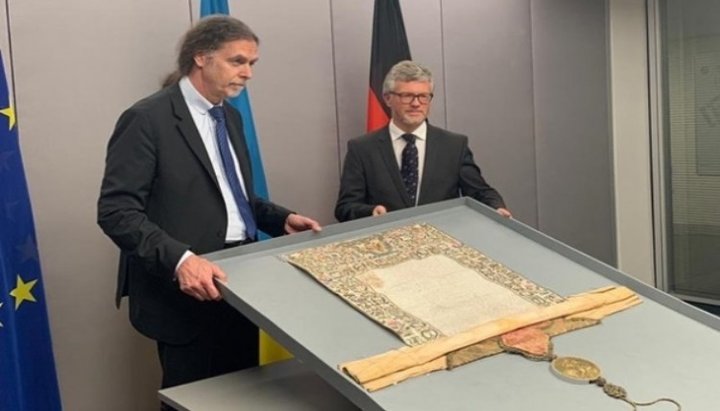
Germany gave back to Ukraine the ancient letter of Peter I
Germany returned to Ukraine the Letter of the Russian Tsar Peter I on the appointment to the Kiev Throne of the last Metropolitan of Kiev, elected in Kiev. The document also stipulates his rights and the position of the Kiev Metropolis. The document has been kept in Germany since the Second World War, according to DW.
Germany’s Federal Foreign Office noted that the original document has been in the library of the Institute for Eastern European History and Area Studies of the University of Tubingen in the federal state of Baden-Württemberg since the 1950s.
The German-Ukrainian expert group concluded that the Nazis must have carted off the Letter as a war trophy in 1941 from Kiev to Germany. The Federal Foreign Office helped the German-Ukrainian research group study the document. The work was carried out from July to October 2016 in the archives of Kiev, Berlin, Tubingen and Freiburg im Breisgau.
Theresia Bauer, Minister of Science, Research and the Arts of Baden-Wurttemberg, decided to give the document to the Ukrainian side upon coordination with the Federal Foreign Office and the University of Tubingen.
“I am grateful to the researchers from Tübingen and Ukraine for their important work and conclusions regarding how the Letter of the king went to the University of Tübingen. The fact that we can now return to Ukraine this symbolic and very important document that was carted off to Germany is also a sign that our country understands its historical responsibility,” Bauer noted.
The royal charter is an important church historical document. This is a confirming letter of the Russian emperor Peter I dated 1708 to Metropolitan Joasaph (Krokovsky) on the appointment to the Kiev Throne of the last Metropolitan of Kiev during his stay in Kiev as part of the Russian Empire, who was freely elected by the Kiev clergy and approved by the tsar, and not directly appointed from Moscow.
Also, Metropolitan Joasaph is known as the bishop, who proclaimed anathema to Ivan Mazepa.
The old document was handed over to the Ukrainian Ambassador to Germany Andrei Melnik.
“How symbolic: the other day it will meet our Tomos,” the Ukrainian diplomat said.
As reported by the UOJ, the Phanar in its claims to the church territory of Ukraine refers to the historical documents of 1686.
Read also
Medieval сhurch сrumbles as Culture Ministry сites missing agreement
The 14th–15th-century St. Nicholas Church in Chesnyky, Ivano-Frankivsk Region, is falling into disrepair.
Poland сondemns Lviv Regional Council's decision to declare 2007 year of UPA
Polish Prime Minister Donald Tusk says the Lviv Regional Council's decision to dedicate 2027 to the UPA and Roman Shukhevych is harmful to Ukraine.
OCU seeks court recognition of ownership of seized Cherkasy cathedral
The Cherkasy Regional Commercial Court will hear an OCU lawsuit seeking ownership of St. Michael's Cathedral, which was seized from UOC believers.
Lithuanian bishop: Ukraine is no model for believers' rights
Vicar of Vilnius Diocese voices concern over attempts to import Ukraine's religious conflict into Lithuania.
Hundreds of believers honor St. Alexis of Carpatho-Russia in Khust Eparchy
At the St. Nicholas Monastery in the village of Iza-Karputlash, Metropolitan Mark of Khust led a festive liturgy, concelebrated by six metropolitans, five archbishops and three bishops.
Court upholds UOC parish appeal in Voloshky over OCU switch dispute
The Northern Commercial Court of Appeal has upheld the appeal of the St. Nicholas parish of the UOC in the village of Voloshky, Volyn region, in a dispute over a transfer to the OCU.