Baranovka: Chronicles of the failed assault on UOC temple
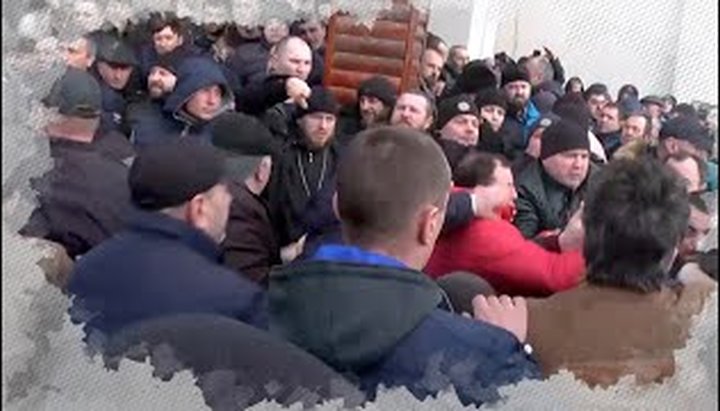
An assault on the Church of the UOC of the Nativity of the Most Holy Theotokos in Baranovka
On March 10, 2019, in the town of Baranovka, Zhitomir region, extraordinary events took place. Despite the fact that the large community of the UOC church unanimously expressed its loyalty to the UOC led by His Beatitude Onufriy, the local authorities organized another, territorially “patriotic” community, which includes town residents but not a single parishioner.
These people were provoked to storm and seize the temple.
On Forgiveness Sunday, the Radical Party deputy Oleg Kovalsky convened a town’s meeting (“veche”) on the main square, in which he called upon those gathered to take over the Church of the Nativity of the Most Holy Theotokos. As a result, the crowd, fueled with “correct” incitement, rushed to the temple. Parishioners were beaten, dragged from the porch and thrown out of the church fence. At that time, about 150 parishioners locked inside after the Sunday Liturgy, many were with their children.
Though the raiders cut the doors with a grinder, they did not manage to break in. Late in the evening, the ruling bishop of the Zhitomir Eparchy, Metropolitan Nikodim, came to support his flock. The doors were welded back, the parishioners withstood the assault.
Read also
Where the Spirit of the Lord is, there is freedom
Reflections on the controversies surrounding the creation of the OCU.
Pentarchy with Rome: A return to the roots or a new schism?
Patriarch Bartholomew wants to revive a council of five patriarchates, including Rome. What would reunion with Catholics look like, and what role would be left for the other Churches?
Concubine or daughter? On words that cannot be used about the Church
An archon of the Church of Constantinople likened the UOC to Moscow’s “concubine.” But for St. Epiphanius of Cyprus, “concubines” are heresies.
Shameful chronicle of one week: how the OCU was born
Exarchs under escort, a call from the operations room, and 36 votes for Epifaniy: what a member of the Phanar delegation revealed about the 2018 "Council".
Can UOC eparchies be dissolved before court ruling on Metropolia?
DESS is launching separate proceedings against UOC eparchies, monasteries, and institutions while the case involving the Kyiv Metropolia is still pending.
Two murders, one silence
Zelensky condemned the killing of a Catholic priest in Poland the very same day. A month earlier, a UOC monk was murdered at the Sviatohirsk Lavra – and the president has remained silent ever since.