Two villages of Rovno region face raider attacks on UOC temples
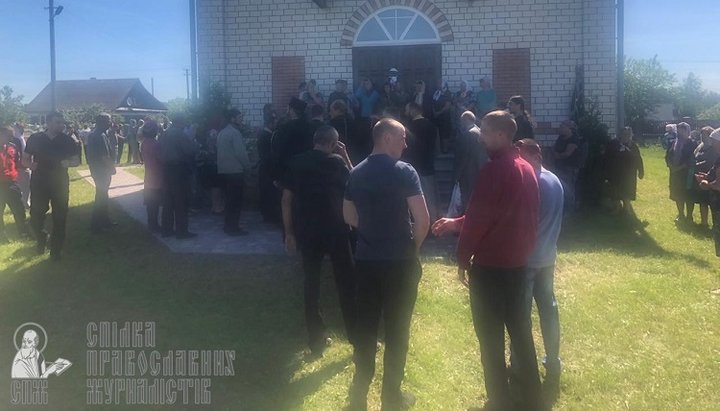
St. John the Theologian Church in the village of Mashcha, 01.06.2019. Photo: UOJ
Power confrontation continues near the churches of the UOC in the villages of Povcha, Dubno district, Mashcha, Kostopol district of the Rovno region. The police and non-residents in camouflage are present on the scene of the conflict, reports a UOJ correspondent.
On Saturday, June 1, 2019, a church battle broke out around the St. John the Theologian Church in the village of Mashcha. Eyewitnesses said that OCU activists came to the temple territory with newly issued documents and demanded that the UOC believers give up the church.
“Meanwhile, the police are not taking any action, keep aloof from the conflict, however, in private conversation, the head of the Kostopol regional police department Mr. Bortnik told me that if the OCU community appeals to the executive service, they will bring it to life and suspend our community,” commented on the situation Archpriest Viktor Zemlianoy, head of the Department for Interfaith Resolution at the Rovno and Sarny Eparchies of the UOC. “In response, I told him about the situation in the village of Badovka of the Ostog district, where our community, having all the documents to the church and court decisions in its favour, has applied to the executive service three times, and the church still belongs to the UOC KP. So, where is justice?”
It is known that in the village of Mashcha, OCU supporters have registered their religious community on the basis of a decision taken at a meeting of the territorial community of the village. At the same time, the decision of the parish assembly of the UOC community, at which the believers by a majority vote supported the canonical Church, was completely ignored.
As reported, some men in camouflage are involved in today's conflict, which is developing round the St. John the Theologian Church in the village of Mashcha. According to eyewitnesses, these are the very people who helped church raiders in the village of Lisopol of Kostopol district.
The same morning, power confrontation on the religious ground began in the village of Povcha. The details of the conflict are not yet known, but, according to preliminary information, supporters of the OCU from neighboring villages and men from the Cossack Guard, who in 2015 - 2016 helped grab temples in Ptichye, Rachin and Belogorodka of the Dubno district, were brought to the church of the UOC.
As reported earlier, on May 30, 2019, the Holy Trinity Church of the UOC in the village of Ivanichi, Rovno region, was sealed until the church issue is regulated in court.
Read also
Ukrposhta issues stamp featuring Lavra for Soviet-era reserve's anniversary
The new postal block, issued in a print run of 40,000 copies, depicts the Lavra's churches, bell tower, and ancient frescoes.
Met. Theodosiy links his criminal case to ex-prosecutor named in NABU tapes
A Cherkasy court extended Metropolitan Theodosiy’s preventive measure for another two months – until November 29, 2026.
Stefanchuk: Seeking UCCRO-LGBT compromise on new Civil Code
The Verkhovna Rada speaker said the working group is seeking a broad public compromise as it revises the draft of the new Civil Code.
Rabbi thanks SBU for arresting Ukrainian over antisemitic threats
Moshe Azman called for those who incite religious hatred to be held accountable, warning that the line between online threats and real-world violence can be very thin.
Pochaiv Lavra calls for fasting ahead of Kyiv Metropolia court hearing
The Pochaiv Lavra Spiritual Council called on the faithful to unite in prayer and fasting from October 5 through 7.
Russian strike damages Sts. Peter and Paul Church in Sumy for fourth time
One of the aerial bombs struck the cemetery in Sumy, causing extensive damage to the church’s facade, roof and interior.