Greek hierarch: Autocephaly of OCU doesn't rule out UOC and Met. Onuphry
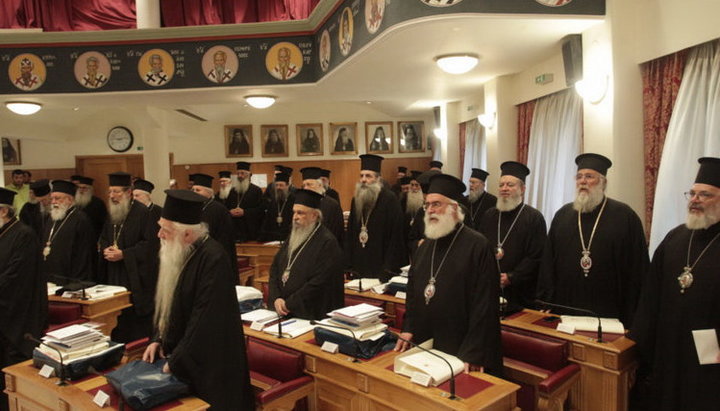
Extraordinary meeting of the Bishops’ Council of the Greek Orthodox Church. Photo: romfea.gr
On October 12, 2019, at an extraordinary meeting of the Bishops' Council of the Greek Orthodox Church, Metropolitan Ignatius (Georgakopoulos) of Dimitriades and Almyros, chairman of the Synodal Commission for Orthodox and Inter-Christian Relations, made a report titled “Ukrainian autocephaly and responsibility of the spirit”, Romfea reports.
The document stated that the bestowal of autocephaly to the OCU does not foresee that the UOC, led by His Beatitude Metropolitan Onuphry of Kiev and All Ukraine, no longer operates in Ukraine: “The granting of autocephaly is a prerogative of the Ecumenical Patriarchate, but it does not deny the essence and presence of Metropolitan Onuphry and the Russian church presence in Ukraine. It does not change its status, it does not concern them, nor does it lead to a split. The Ecumenical Patriarchate does not cease its communion. They broke off the communion with it. The Ecumenical Patriarch continues to make a liturgical mention of Patriarch Kirill.”
As explained, “The Ecumenical Patriarchate acted on duty. ...> He came to solve the problem that could not be solved otherwise. He does so because it is his ministry, this is his duty in Orthodoxy.”
Therefore, says the hierarch, Constantinople continues its relation with the UOC, “but it gives the opportunity to save the souls of Ukrainians who want to be in the Orthodox Church of Ukraine. No one can challenge the right of the Patriarch.”
The report says that the Russian Orthodox Church “cannot offer a solution to the Ukrainian people” and “did not want a dialogue for almost 30 years”, while “the Ecumenical Patriarchate has contributed to this dialogue by supporting efforts.” “After the invasion into Crimea, everything collapsed. Now no one believes that the Russian Church will ever be able to offer a solution to the Ukrainian people. ...> In fact, the Russian Church not only failed to offer a solution, but even then its position regarding the process of preparing the Pan-Orthodox Council was absolutely negative. This was wrong. ...> Their perseverance was terrible,” the bishop writes, emphasizing that the Russian Orthodox Church was not present at the Cretan Council and “denies primacy in the East”.
Metropolitan Ignatius also speaks of the “responsibility assumed by the GOC”: “Whether it is good or bad, granting autocephaly was based not only on intra-church factors. This was due to geopolitical events. I’m sorry that some do not understand what is happening in our time and what responsibility we bear.”
Recall, Phanar hierarchs have repeatedly affirmed that their actions are aimed at the complete unification of Orthodoxy in Ukraine. Archbishop Job (Getcha) stated that the Patriarchate of Constantinople would not create parallel church jurisdiction in Ukraine and also that there should be only one Church in the territory of our state: “According to the canons of the Church, there cannot be two parallel Churches,” noted the hierarch. “If some people can speak out that whoever doesn’t want Ukrainian autocephaly can remain as Russian exarchate whatever, it’s just anti-canonical.”
As reported by the UOJ, on October 12 the official communiqué of the Extraordinary Bishops' Council of the Greek Orthodox Church was published. The Council recognized the “canonical right” of Phanar to grant autocephaly, as well as the privilege of the Primate of the Church of Greece to further deal with the issue of recognition of the Church of Ukraine.
The seven metropolises of the Greek Orthodox Church requested a delay in making their decision on the proposal of Archbishop Ieronymos of Athens and All Greece “to recognize by our Church the autocephaly of the Orthodox Church of the independent Ukrainian Republic,” who considered the proclamation of church autocephaly of Ukraine “extremely beneficial for the Orthodox Church and valuable in strengthening relations between the two autocephalous Orthodox Sister Churches, Great Rus and Ukraine.”
Read also
Lionel Messi thanks God for his achievements as he ends international career
Argentine football star Lionel Messi credited God for his success as he brought his international career to a close, saying he could never have achieved so much without God's will.
Odesa’s St. Elijah Monastery honors memory of its founder
Metropolitan Agafangel led celebrations at St. Elijah Monastery in Odesa on the feast day of St. Gabriel of Mount Athos.
OCU cleric rejects suspension, accuses ruling bishop of usurping power
An OCU cleric called the decree suspending him "canonically null and void" and accused "Bishop" Semanchuk of attempting to seize parishes and using mobilization threats as blackmail.
Supreme Court: Religious beliefs do not exempt citizens from mobilization
The Supreme Court has clarified that Ukrainian law does not provide for alternative civilian service under martial law.
Ukraine birth rate drops 17%, demographer says
The head of a department at Ukraine’s Institute of Demography has reported a sharp decline in the country's birth rate.
Khust Eparchy honors memory of St. Job of Uholka
A Liturgy is served in Mala Uholka, a birthplace of St. Job of Uholka, on the saint's feast day.