Yurash: Amount of UOC parishes matters nothing – OCU is still bigger
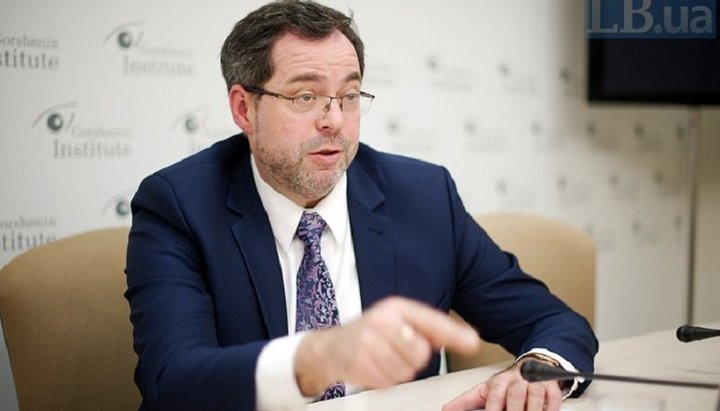
Andrei Yurash. Photo: LB.ua
In Ukraine, there are stable 12–16% of believers who uniquely associate themselves with the UOC, said Andrei Yurash in an interview with LB.ua.
“I am a scholar who relies on sociology,” the official noted. “This year, Razumkov Center’s poll hasn’t given any sociological data in this regard, but in the past nearly 40% of those, who identified themselves with the Moscow Patriarchate, would seek a Local Autocephalous Church.”
In his opinion, these people represent the "unrealized potential" of the OCU, the transitions to which were "absolutely artificially" suspended due to the huge number of "organizational, ideological, external circumstances", but "sooner or later this movement will continue."
“In most regions, communities and individual believers who, due to various circumstances, are now located in the structures of the Moscow Church, but affiliate themselves with the Local Church, have neither the resources nor the opportunities to go to the OCU,” said Yurash. Let's take Odessa region. There, in every second village there is a community that is under the jurisdiction of the Moscow Patriarchate. And no matter how many supporters of the Local Church there may be, they still have no opportunities for self-organization and implementation of the potential within the framework of independent structures as part of the local tradition.”
At the same time, he said that “in Ukraine there are stable 12-16% of those who have unambiguously associated themselves with the Moscow Patriarchate over the past 20 years, no one denies this,” but the largest religious community in Ukraine is still the OCU.
“There is a difference between the number of communities, i.e. institutions, and the number of people who are related to it. These are completely different things. If in a village in Odessa region there are more believers of the Moscow Patriarchate, it is deemed as a region of complete domination. But look at sociology: 50%, even in Odessa, of those who go to the Moscow Patriarchate every Sunday or once a month, do not relate to it. Therefore, there is a difference between the institutional network and actual ideology of a person. There is no doubt that the largest community is the community of those who support the Orthodox Church of Ukraine,” said Yurash.
The official is convinced that the state should contribute to the realization of the rights of "this largest religious community in Ukraine."
“If the state, for 28 years of its independent existence, has helped all faiths, provided them with premises, then it should also provide the OCU with similar opportunities for administrative development, i.e. guarantee the possibility of equal development. And this will in no case be a violation,” explained the ex-head of the Department of the Ministry of Culture for Religious Affairs. “The state has never financed anyone, but it must ensure the operation of the mechanisms of the current legislation so that 2/3 of the communities who want to go to the OCU can exercise their right and not focus on 5 or 6% of those who knowingly generate a protest and have external legal assistance and financial support, which is why the lawsuit may be considered for years. We know how our courts can handle these issues for years. Therefore, it is precisely about the provision of mechanisms for the current legislation.”
Recall, Andrei Yurash considers the Tomos the brightest achievement of the Ukrainian state in 102 years.
Read also
Upper Lavra court hearing postponed
The next court hearing in the Upper Lavra case has been scheduled for November 3.
UOC priest blesses ambulances at Kamianske medical center
A UOC priest in Kamianske blessed ambulances for a medical facility and wished its doctors God's help in their work.
Dumenko to German ambassador: Law targeting UOC also applies to other groups
Epifaniy Dumenko sought to defend Ukraine’s law restricting religious organizations during a meeting with the German ambassador.
Activists bused to court hearings in UOC cases, media say
A minibus has been spotted transporting protesters to and from courthouses where UOC cases are being heard.
Firefighters save historic UOC church from fire in Zakarpattia
A fire broke out at a UOC church in the Tiachiv district, damaging the altar and church furnishings.
Volyn Eparchy faithful collect six tons of aid for Sviatohirsk Lavra
Believers in Volyn collected food and warm clothing for people displaced by the war who have found shelter at Sviatohirsk Lavra.