UOC cleric: Authorities think temple is a "get-together" one can do without
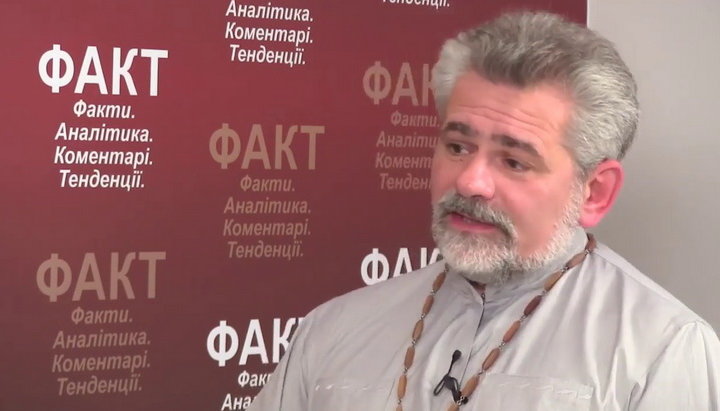
Fr. Alexander Kanevsky. Photo: YouTube / RodCom-TV
On March 21, 2020, Fr. Alexander Kanevsky, an employee of the UOC Synodal Department for Education, Catechesis and Missionary Work, spoke about the problems in the authorities’ understanding of the importance of attending the church for believers, including during the coronavirus epidemic, reports “Fact”.
“The main problem of the current situation is that secular authorities see in the divine services “the satisfaction of religious needs” of people. People in power believe that believers are going to church just because it's a way of entertainment for the faithful, a kind of "get-together, which one can do without for some time.
Actually, we do not come to the temple to “rest our soul”, as some say, but to turn to the One, Whom alone our life, every step we take, every breath we take depend on. And under the circumstances, if we want to avoid infection, to whom else do we all have to go to if not to Him, Who this depends on in the first place? Do you understand? And we are suggested not to do this. A paradox!” the clergyman explains.
Speaking about the meaning of the Communion, he emphasizes: “The Sacrament of the Holy Mysteries of Christ is a real union of man with Christ. Christ offers Himself under the guise of Bread and Wine. Bread and Wine are offered at the beginning of the service during the Eucharist (this is the most important part of the Liturgy), i.e. they are transformed by the action of the Holy Spirit into the true Body and Blood of Christ the Saviour. The Body and Blood of Christ is the main shrine of the Orthodox Church. This is Heavenly Fire, in which all bacteria and germs burn, all our sins and wrongdoings. And in the entire history of Christianity, no one has yet been ill from taking the Holy Mysteries of Christ, but millions have been cured, recovered, and saved.”
“At the time of the worst epidemics, people came to the temple in search of a cure in the Communion – and found it! And today, the Romanians began to talk about disposable spoons for the Communion – thereby allowing the impossible thought of being infected from the Holy Body and Blood of Christ! Madness!
Are you afraid of Christ? Well then, why are you going to Him? Stay home! And I believe that everything is sterile in the temple of God. And the cross, and the icons – all!
And today's virus, no matter how terrible it may seem, could not have happened without the will of God or God's connivance. This means that its cessation depends on God and on our repentance. In all such situations, the Church has always called for prayer. It calls for prayer now, too.
We should shut down drinking places rather than close temples. And not ban services but gay propaganda, the propaganda of violence, nationalism, propaganda of war. Then, God willing, the coronavirus will not come to us anymore!” the priest concluded.
As reported, the UOC published the text of a special prayer to counter the coronavirus.
Read also
UOC priest killed in war laid to rest in Kovel
The Volodymyr-Volynskyi Eparchy bid farewell to Archpriest Andriy Korinchuk, rector of several parishes, who was killed in the war.
Vyshhorod mayor accused of damaging monument to Sts. Boris and Gleb
The creators of the monument to Sts. Boris and Gleb accused the Vyshhorod mayor of damaging it and demanded that it be restored to its original appearance.
Bulgarian Primate responds to criticism of Patriarch Bartholomew's visit
Patriarch Daniel stressed that in Church matters, efforts should be made to achieve unity rather than seek reasons for division.
UOC faithful honor St. Filaret of Chernihiv
Archbishop Nikodym of Liubech celebrated the Divine Liturgy at the Church of All Saints of Chernihiv on the feast day of St. Filaret.
Two UOC churches damaged in Russian shelling of Kramatorsk
The UOC's Intercession and St. Nicholas churches were damaged in Russian attacks on Kramatorsk in the Donetsk region.
500 UOC faithful make procession from Chernivtsi to Kolenkivtsi Monastery
Around 500 Orthodox Christians from Bukovyna walked 25 kilometers from Chernivtsi to St. Prince Volodymyr Monastery.