Lithuanian Church: Our communion with Moscow is exclusively canonical
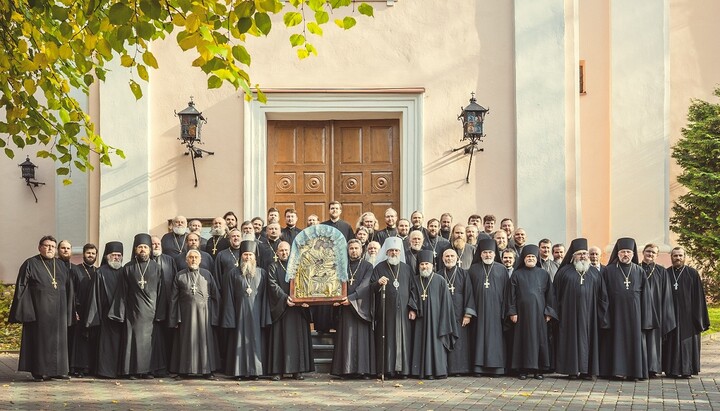
Clergy of the Vilnius-Lithuanian Eparchy with the miraculous Surdega Icon of the Mother of God. Photo: Aliaksei Litvinau
The press service of the Vilnius-Lithuanian Eparchy told the UOJ that the church as a Lithuanian religious association remains morally, spiritually and financially independent. All decisions are taken in Lithuania, and the connection with the Moscow Patriarchate is exclusively canonical.
According to the press service, many Ukrainian refugees have found spiritual refuge in the Lithuanian Church, and they actively participate in parish life, sing in the choir and perform other services.
"Our parishes, as well as the eparchy as a whole, are working hard to provide comprehensive assistance to refugees – both material and spiritual. The vast majority of refugees from Ukraine of the Orthodox faith in our country prefer to attend services at our churches, which are conducted in the Church Slavonic language. For those of them who wish to pray in their native language, regular services are held in Ukrainian," the report said.
The Eparchy of Vilnius-Lithuania recalled that Patriarch Kirill is not commemorated at these services so that the faithful of other Local Churches "can concentrate on prayer".
"This practice has been in place for quite some time, so as not to create additional obstacles for people who fundamentally disagree with the statements of Patriarch Kirill. The same applies to regular services in Lithuanian, Belarusian, Georgian, Greek and English. Also, once a week, services in the Church Slavonic language are held in the Assumption Cathedral without commemoration of Patriarch Kirill,” the press service’s statement clarifies.
The term "Russian-Orthodox minority" used by the Prime Minister causes extreme bewilderment among Lithuanian believers.
"As we know, the overwhelming majority of parishioners in the Vilnius-Lithuanian Eparchy are Lithuanian citizens. At the same time, the Vilnius-Lithuania Eparchy (Lietuvos Stačatikių Arkivyskupija) was recognised as a traditional religious community in Lithuania after the restoration of independence and has consistently supported democracy and peace in the world ever since. As for the epithet "marginal" used in the interview in relation to the Orthodox minority, anyone who reads the results of the 2021 census (according to which 3.75 per cent of Lithuania's population, or over 100,000 people, are Orthodox) can judge for themselves whether it is appropriate or not. Finally, it is fundamentally wrong to say that the former clergymen who were expelled from the priesthood "had to leave the Church because they disagreed with the position of the Moscow Patriarchate," the eparchy’s statement said.
"The Primate of the Orthodox Church of Lithuania himself, Metropolitan Innocent, publicly expressed his disagreement in principle with the statements of Patriarch Kirill. His position was supported by thousands of the laity and almost the entire clergy. All this in no way prevents them from remaining in the fold of the Church. The former clerics of the Eparchy of Vilnius-Lithuania were defrocked not for their anti-war stance, but for having committed a number of grave ecclesiastical crimes such as the violation of the priestly oath and oathbreaking, conspiracy against their bishop and fellow clergy, the destruction of the Church peace, schismatic activity, etc. This gives the impression that government circles lack comprehensive and objective information about the affairs of the Orthodox Church in Lithuania. A constructive dialogue, which the priesthood of the Vilnius-Lithuania Eparchy has been calling upon the authorities since the outbreak of the war in Ukraine, could remedy this," the Chancellery of the Lithuanian Orthodox Church notes.
As earlier reported, the Lithuanian Church explained why Patriarch Kirill is not commemorated at all services.
Read also
Medieval сhurch сrumbles as Culture Ministry сites missing agreement
The 14th–15th-century St. Nicholas Church in Chesnyky, Ivano-Frankivsk Region, is falling into disrepair.
Poland сondemns Lviv Regional Council's decision to declare 2007 year of UPA
Polish Prime Minister Donald Tusk says the Lviv Regional Council's decision to dedicate 2027 to the UPA and Roman Shukhevych is harmful to Ukraine.
OCU seeks court recognition of ownership of seized Cherkasy cathedral
The Cherkasy Regional Commercial Court will hear an OCU lawsuit seeking ownership of St. Michael's Cathedral, which was seized from UOC believers.
Lithuanian bishop: Ukraine is no model for believers' rights
Vicar of Vilnius Diocese voices concern over attempts to import Ukraine's religious conflict into Lithuania.
Hundreds of believers honor St. Alexis of Carpatho-Russia in Khust Eparchy
At the St. Nicholas Monastery in the village of Iza-Karputlash, Metropolitan Mark of Khust led a festive liturgy, concelebrated by six metropolitans, five archbishops and three bishops.
Court upholds UOC parish appeal in Voloshky over OCU switch dispute
The Northern Commercial Court of Appeal has upheld the appeal of the St. Nicholas parish of the UOC in the village of Voloshky, Volyn region, in a dispute over a transfer to the OCU.