UOC hierarch: One can be saved without temples, but without sacraments – no
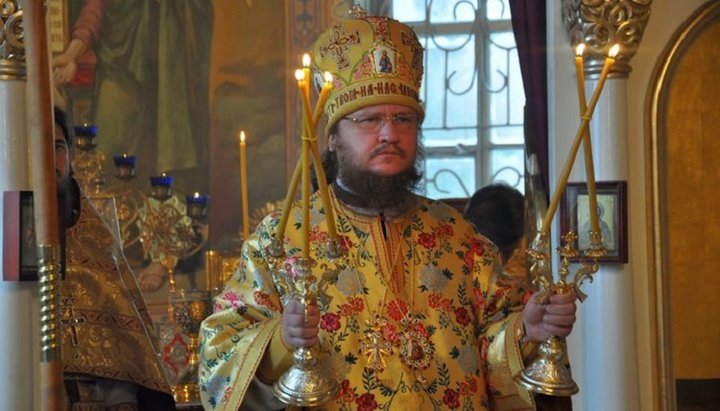
Archbishop Theodosius (Snigirev) of Boyarka. Photo: search.rf
Man achieves salvation not in a temple but in the sacraments of the Church, according to the vicar of the Kiev Metropolis, Archbishop Theodosius (Snigirev) of Boyarka. The hierarch spoke about this in an interview with Pravoslavie.ru.
“Now the theological polemic on this subject has stepped up in the Church: is it possible or impossible to live without a temple?" noted Abp. Theodosius. “I’ll say right away that the time may come when one will have to live without temples like generations of the first three centuries of Christians. May God forbid us to live up to this time. But our task, the modern Orthodox, is to think over and develop the life forms of the Church in any conditions, even when our temples are removed. After all, sooner or later this time may come.”
According to him, “it is possible to live and be saved without majestic temples. But one cannot live and be saved without the grace of the sacraments.”
“The value of the Orthodox temple lies precisely in the fact that the grace of the sacraments is poured into a person’s life,” he explained. But the sacraments can be performed outside the walls of the temple. A temple can stand without sacraments performed, bloodless and devoid of its purpose and meaning. Like, for example, Hagia Sophia in Istanbul. So salvation does not occur in a temple but in the sacraments of the Church. The time may come (let's honestly and meaningfully delve into the words of the Apocalypse), when we will not have our temples. What then? Should spiritual life stop? Should the sacraments cease to be performed? Of course, not. And our task is now to think how to survive in these conditions. The global pandemic spurred us on to this.”
According to the hierarch, the pandemic and the subsequent closing of temples should “move us to urgently and systematically begin to develop alternative ways for the faithful to participate in the blessed sacraments of the Church.”
In particular, he did not rule out the possibility of Confession by means of modern communication: “Moreover, in the conditions of life in which the Church has appeared now, during the pandemic, this method of Confession can even become the main one.”
“However, any change in the form of the sacrament, of course, should be considered and blessed with a conciliar mind,” Abp. Theodosius emphasized. “This should not be a personal decision of one of the confessors or hierarchs. Generally speaking, sacraments or ceremonies that require personal contact or participation of a person in the sacrament cannot be performed remotely. But Confession in this series is an exception. And this exception was repeatedly the case in the spiritual life of 20th-century Orthodox Christians.”
With regard to the Sacraments of the Church, it may be necessary to turn to the practice of the Holy Communion using spare Gifts, which existed from the first centuries of Christianity.
“If, with the onset of the end times (eschatological persecution, pandemic, radiation infection), our Church will be forced to return to this practice, then it will be possible to give spare Holy Gifts to only those faithful, who are truly practicing believers. Each confessor in this case should have their own lists of church members, and ‘random people’ will not be included in such lists," he stressed, adding that it is necessary to think over the way of storing and transferring the Holy Gifts to the laity "alongside the forms of transferring the Holy Gifts to believers who die in infectious hospitals, where priests are not allowed.”
As reported by the UOJ, Archbishop Theodosius of Boyarka believes that the coronavirus pandemic prepares the Church for the end times.
Read also
OCU eparchy sells church center site to developer for housing
The OCU’s Volyn Eparchy sold land intended for a spiritual center to a private developer planning to build townhouses and residential buildings.
SBU names UOC priest’s wife a suspect in Cherkasy region
The SBU accused Matushka Kateryna Prykotenko of “spreading enemy propaganda” through correspondence with parishioners.
UGCC cleric calls Russian Orthodox literature dangerous for clergy
While examining the causes of divisions within the UGCC, Yustyn Boiko concluded that Russian Orthodox literature had influenced Greek Catholic clergy.
UOC will play major role in achieving peace, says Vadym Novynskyi
UOC Protodeacon Vadym Novynskyi believes the Church will help bring about reconciliation within Ukrainian society after the war ends.
Catholic media outraged by forcible conscription of Uniate cleric
The Vatican’s Apostolic Nunciature has demanded the return of a forcibly mobilized Greek Catholic cleric.
Rivne court fines man for criticizing parish's "transfer" to OCU
A resident of the Rivne region was convicted over Facebook posts criticizing the “transfer” of a religious community in the village of Butove to the OCU.