“Picasso”: Aunt Masha and a Sleepless Night of Father and Son
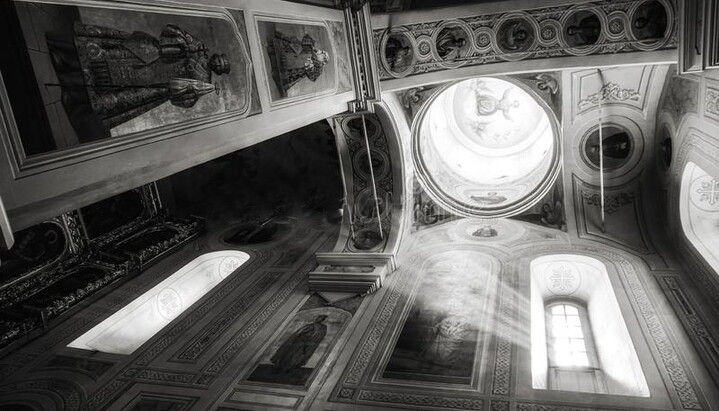
Photo: dreamstime.com
Time: 1987
Place: Kyiv
Characters: Kirill Bulatov, Misha Kaminsky, both twelve years old
He found his own company in the same place as before. They were still passionately absorbed in their card game.
“Where have you been so long? We were starting to worry,” his mother asked with a hint of reproach.
“Oh, just walking,” Kirill answered vaguely.
He sat down on the blanket, buried his feet in the hot sand, and gazed at the volleyball game. But his thoughts were elsewhere. He kept thinking about the church and the boy he had seen there. Strange—why had that boy chased after him? Just to announce that God exists? Odd. And yet… maybe He really does? Surely there must be something.
Yes, there must be something.
* * *
That evening, Aunt Lyuba hosted guests. Besides the Bulatovs, there was Uncle Zhenya—their companion at the beach—and one of Aunt Lyuba’s friends with her husband.
Introductions were made. The friend’s name was Aunt Masha, her husband was Uncle Volodya. Aunt Masha turned out to be cheerful, talkative, and lively.
While the women prepared the food and set the table, the men smoked on the balcony and discussed some weighty problem of global importance.
At table the mood was festive. Everyone ate, drank, and grew tipsy. The men—from vodka, the women—from wine, though all about equally. Kirill was not given any, which left him slightly resentful.
As the meal progressed, the conversation, as usual, wandered from small matters to great ones. By dessert, they had arrived at religion—a fresh topic for Soviet people, though everyone pretended to be well-versed in it.
Voices grew heated, arguments flared. At first Kirill tried to follow, but soon gave up. Only one phrase stuck in his memory, spoken by Aunt Masha:
“If Christ exists, let Him exist,” she said, licking cream from her finger. “I don’t object. But on one condition: let Him be on His own, and I’ll be on my own.”
Kirill said nothing—it wasn’t required of him. But his twelve-year-old mind protested.
If God exists, then we cannot live on our own. That’s… that’s impossible. Not on our own… But then again, He doesn’t exist… probably.
* * *
That night Misha the altar boy could not fall asleep. He had made the greatest discovery of his life: God exists!
He had lived with this discovery all day since his encounter in the church with that other boy. It burned within him, too great for his heart to hold. He longed to lean out the window and shout it across the sleeping city:
“People! God exists!”
A pity they wouldn’t understand. They’d be annoyed, perhaps, that God existed and disturbed their sleep. Yet he yearned to share this precious, secret knowledge with some living soul.
The victim of this irrepressible desire was his father. Misha tiptoed into his room and shook his shoulder.
“Papa… Papa…”
“What is it?” his father mumbled drowsily.
“I want to tell you something.”
“Tell me,” said his father, half-asleep, struggling to answer without really waking, eager to drift back into slumber.
The night before, he had served Vespers, then heard confessions for an hour, then had a long talk with a man who desperately needed the priest’s ear. After that, he had prepared the church for the next day’s Liturgy. At home he had helped his wife feed and put the children to bed, read a bedtime story to the younger ones, cleaned wax stains from his epitrachelion, drafted his sermon, read the evening prayers and the rule before Communion. Finally, with his prayer rope in hand, he had whispered two hundred invocations: “Save, O Lord, and have mercy on my children—Michael, Sergius, Olga, and Andrew—and grant them knowledge of the truth.”
He repeated that prayer every night, usually drifting into sleep over it. That night the rope had slipped from his weary hands more than once. At last he had finished, collapsed on the divan, and within minutes had sunk into the dead sleep of exhaustion.
And then—a tug at his shoulder, a voice:
“Papa… Papa…”
“What is it?”
But Misha would not be fobbed off by a half-sleeping father. He wanted him fully awake, for what he had to say could not be spoken into a dream.
“Tell me.”
“No, Papa, get up… get up,” Misha pulled his hand. At last his father sat up, rubbing his eyes.
Irritated, he asked:
“Well then, what is it?”
“You know, Papa—” Misha’s eyes shone with a light that seemed to pour out of them. “God exists!” The light in his eyes blazed brighter still.
And how could it not? He had spoken a truth beyond all truths. Not to just anyone, but to the rector of the parish, Archpriest Alexander, master of theology, and most of all—to his beloved father.
His father’s first impulse was to drop back onto the divan, muttering something like, “Yes, yes, that’s fine, son.” But then he saw it—that light in his twelve-year-old’s eyes. His son’s eyes. And suddenly he understood: this was what he had prayed for all these years, what he had murmured half-asleep on his beads: “Save, O Lord, and have mercy on my children…”
The father embraced Misha tightly. They understood one another. After that, neither could sleep. They talked through the night. The father told stories of his own childhood, his youth—how he had also served in the altar, how he had met Misha’s mother. Misha shared his own stories. They laughed, remembered, dreamed.
And only toward morning, when it was time to leave for church, did Misha ask the question his father could not answer:
“Papa, how can you tell another person that God exists?”
To be continued…
The previous episode of the book is available here.
Read also
Stories of the Early Church. Level of governance: patriarch
How did several episcopal sees rise above the rest, why did the Church’s administrative map come to mirror that of the empire, and is the patriarchate a sacred form of Church governance?
A Chronicle without an author
We are accustomed to calling The Tale of Bygone Years the work of St. Nestor. Yet another monk left his signature on it, while the chronicle itself passed from one generation of scribes to the next.
How a wedding stopped a war
The young princess of Slutsk was married off to keep two powerful noble families from drowning the city in blood. Soon afterward, a Uniate metropolitan complained that Orthodoxy had been reborn in Slutsk.
Man before the forces of nature
A solitary figure on the shore seems insignificant before the immense power of the sea, yet it is he who stands before the Creator.
The mysteries of Golgotha in the light of archaeology
The veil of centuries obscures what really happened in the fourth century. Archaeology and ancient texts shed light on the true history of one of Christianity’s greatest sacred sites.
Zaporozhian Cossacks defend the persecuted faith
The story of how Cossacks drew their sabers to defend abused priests – while sometimes causing violent disturbances inside churches themselves.