Bohdan: DESS examination will lead to an absurd situation
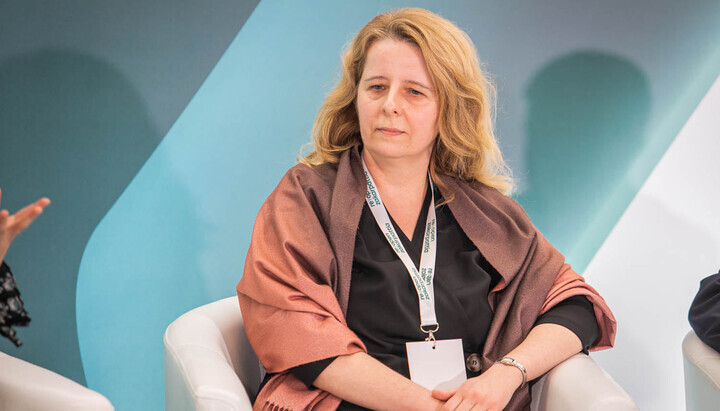
Olena Bohdan. Photo: irp.news
In an interview with Viche, the ex-head of the State Service for Ethnopolitics and Freedom of Conscience, Olena Bohdan, said that the conclusions of the DESS examination on the discovery of church-canonical relations between the UOC and the ROC are unsubstantiated and full of assumptions.
Olena Bohdan criticized the composition of the specialists invited by the State Service for Ethnopolitics, as at least four of them have a conflict of interest.
The former head of the DESS said that the examination proceeds from the fact that the decisions of the Council of Bishops of the Russian Orthodox Church are binding on the UOC in accordance with the letter of Alexy II. Although, in her opinion, this issue is polemical, since the letter says that the Russian Orthodox Church hopes that this will be the case.
“Further on, given the aforesaid, the experts take the papers of the ROC and conclude on their basis that all this is now in the UOC. However, a simple question arises: what are the decisions that the UOC is now making not in Kyiv, but in Moscow? No one can name such a decision. In response, we can hear only speculation about ROC’s secret coordination. These assumptions should be dealt with by the SBU, if it seems that there may be some kind of secret coordination of Ukraine on the RF’s part. If it is true, then we must specifically find out what is being coordinated and how it has harmed Ukraine. Instead, the state says, ‘Stop being coordinated secretly,’ to which the religious organization replies, ‘We are not coordinated.’ All this eventually appears as some kind of absurdity,” she said.
According to Olena Bohdan, another part of the examination suggests that the UOC did not proclaim autocephaly. But the UOC never spoke about this, since this immediately entails the problem of its recognition by other Local Churches.
“I don’t understand why there is a political course in the state now to force the UOC to proclaim autocephaly,” concluded Bohdan.
As the UOJ reported, Olena Bohdan noted that the situation when the state dictates to religious associations with whom to have or not to have a canonical relationship is futile.
Read also
Upper Lavra court hearing postponed
The next court hearing in the Upper Lavra case has been scheduled for November 3.
UOC priest blesses ambulances at Kamianske medical center
A UOC priest in Kamianske blessed ambulances for a medical facility and wished its doctors God's help in their work.
Dumenko to German ambassador: Law targeting UOC also applies to other groups
Epifaniy Dumenko sought to defend Ukraine’s law restricting religious organizations during a meeting with the German ambassador.
Activists bused to court hearings in UOC cases, media say
A minibus has been spotted transporting protesters to and from courthouses where UOC cases are being heard.
Firefighters save historic UOC church from fire in Zakarpattia
A fire broke out at a UOC church in the Tiachiv district, damaging the altar and church furnishings.
Volyn Eparchy faithful collect six tons of aid for Sviatohirsk Lavra
Believers in Volyn collected food and warm clothing for people displaced by the war who have found shelter at Sviatohirsk Lavra.