Expert: Now the legitimacy of Tomos drifting in the criminal direction
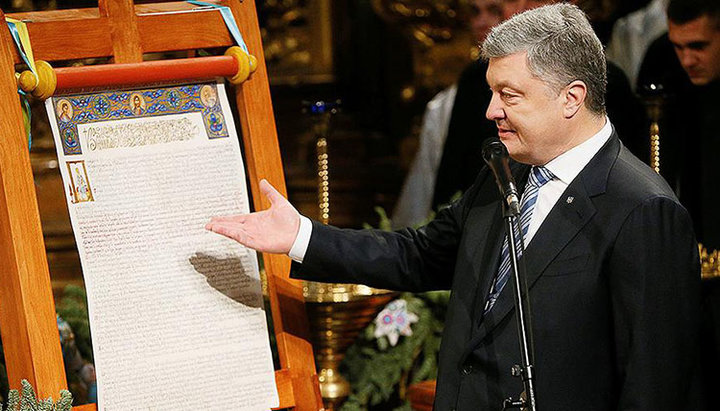
The Tomos tour of the former President of Ukraine Petro Poroshenko. Photo: iz.ru
The State Bureau of Investigation of Ukraine has registered a criminal case against former President of Ukraine Petro Poroshenko under the article on inciting inter-religious hatred during the receipt of the Tomos by the OCU, it is now important that Poroshenko should be held accountable for the deed, said political analyst Elena Dyachenko.
“It is extremely important for the society now to receive a signal from the authorities that justice and legality will be established,” the political scientist said in the “Apostrophe” online edition. “That an official who violates a basic human right – the right to freedom of conscience and religion – will be held accountable under the law, that all unlawful acts will be publicly condemned, and the state will act as an arbitrator and guarantee the implementation of the Constitution.”
According to the expert, this is the only way to achieve the establishment of an interfaith peace in Ukraine, and then a political one.
Dyachenko believes that during the creation of the OCU, Poroshenko not only incited religious hatred, which is still going on, but also exceeded his constitutional authority as head of state when he “deliberately and intentionally” grossly intervened in the affairs of the Church. The Tomos, however, led only to losses and a split.
Dyachenko also explained why the UOC-KP submitted an application against Poroshenko to the State Bureau of Investigations. According to the political expert, the Tomos – “a commercial deal between a politician who wanted to use the Church and a churchman who wanted to use politics” – lost his legitimacy with the withdrawal from the OCU of the Kyiv Patriarchate.
“In the context of relations between Petro Poroshenko and Patriarch Filaret, it is not surprising that this came to the usual denunciation. The fact is that the OCU did not have their churches and property, and, apparently, they did not plan to build them. On the one hand, it was planned to make the eparchies and property of the Kyiv Patriarchate the material basis of the OCU, and on the other, there was a hope for communities of the canonical Ukrainian Orthodox Church to join the OCU. Both both failed,” the expert explained.
Dyachenko noted that Poroshenko did not fulfill the promises made to the head of the UOC-KP Filaret Denisenko, which prompted Filaret to file an application with the SBU and the State Bureau of Investigations.
“With the registration of today's criminal proceedings under Article 161 of the Criminal Code, we can say that the legality of the Tomos is already drifting in the criminal direction,” she concluded.
Poroshenko said earlier that a criminal case was brought against him because of the Tomos for the OCU. Filaret later noted that there is no truth in the OCU’s statement on Poroshenko.
Read also
Khust Eparchy honors memory of St. Job of Uholka
A Liturgy is served in Mala Uholka, a birthplace of St. Job of Uholka, on the saint's feast day.
UOC parish in Cologne donates ultrasound machine to Kharkiv region hospital
In Cologne, UOC believers raised funds for an ultrasound machine for the Kehychivka district hospital in the Kharkiv region.
Shevchuk tells Pope Leo of Ukraine's preparations for "another harsh winter"
The head of the UGCC expressed "special gratitude" to the Pope for his phone calls with Putin and Zelensky.
Berlin hierarch comments on Phanar document published by UOJ-USA
Metropolitan Mark called the information about the 2018 "Unification Council" alarming if confirmed, and expressed hope that Patriarch Bartholomew will reconsider his position.
UOC marks Synaxis of All Saints of Volyn Land at Lutsk cathedral
Metropolitan Serhiy of Ternopil and Kremenets led the Liturgy on the feast day of the Lutsk cathedral of All Saints of the Volyn Land.
SBU detains OCU cleric who organized draft evader's escape for money
In Transcarpathia, law enforcement officers detained a clergyman of the OCU who arranged for a draft evader to be smuggled into Slovakia for $15,000.