Legal Department: AUCCRO’s “full support” for ban on UOC is a manipulation
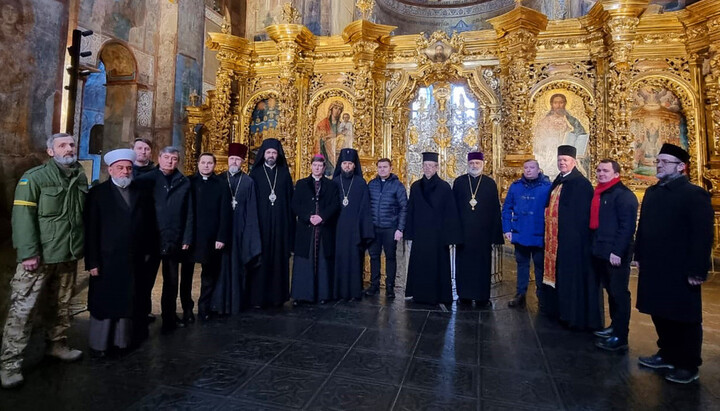
Members of the AUCCRO. Photo: vrciro.org.ua
The Legal Department of the Ukrainian Orthodox Church refuted the statements of Ruslan Stefanchuk, the head of the Verkhovna Rada, and Vyacheslav Horpynchuk, the chairman of the All-Ukrainian Council of Churches and Religious Organizations, that the latter unanimously supported bill No. 8371 aimed at banning the UOC.
The commentary of the Legal Department notes that during the meeting with Stefanchuk on April 11, 2023, only 6 out of 16 members of the AUCCRO spoke about the government bill, and only two structures – the OCU and the UGCC – supported it. At the same time, the representative of the UOC, Archbishop Victor of Khmelnytsky and Starokostiantyniv, not only spoke out against bill No. 8371, but also criticized other anti-church initiatives registered in parliament.
During the meeting, the participants of the AUCCRO supported the list of principles on which state-confessional relations should be based and agreed to discuss them at the next meeting "to form a position on draft law No. 8371." However, the very next day, the speaker of the parliament published a letter signed by the chairman of the AUCCRO, whereby the members of the Council allegedly supported the adoption of bill No. 8371 unanimously. News with similar statements appeared on the AUCCRO website. At the same time, the letter contained a request to take into account the provision of bill No. 8262 (on a simplified seizure of temples) when preparing bill No. 8371 for the second reading.
“Thus, in this case, manipulation occurs: the support of the UOC representatives of the principles of state-confessional relations with an agreement on further discussion at a meeting of the AUCCRO is passed off as support for government bill No. 8371 and other bills,” the UOC Legal Department underscored.
In addition, it is noted that the letter was not agreed with the UOC, although all AUCCRO decisions must be taken by consensus.
“It seems that the leadership of the Verkhovna Rada of Ukraine initiated this meeting in order to present its results in such a way as to cover up or justify before the world community those illegal actions that are being committed today against the UOC. The VR also seems to use the authority of the AUCCRO in order to furnish the public with information to the effect that Ukrainian religious leaders ostensibly support the bill, which is designed to ban the activities of the biggest religious organizations in Ukraine,” the lawyers of the UOC noted.
The Legal Department also emphasized that “all those illegal actions that are being committed today against the Ukrainian Orthodox Church by various activists, proponents of certain political parties with the support of government officials, do not yield any benefit for the objective interests of the state, but instead play exclusively into the hands of the Russian Federation propaganda.”
As the UOJ reported, MP from the Holos party Natalia Pipa called on the Verkhovna Rada to outlaw the Ukrainian Orthodox Church before Easter.
Read also
432 UOC churches damaged in Ukraine during war, report says
According to the Religion on Fire project, 807 religious buildings in Ukraine have been damaged or destroyed as a result of hostilities.
DESS official gives number of clergy exempt from mobilization in Ukraine
A DESS representative said the actual number of clergy exempt from mobilization is significantly lower than the number of religious organizations designated as critical.
Cabinet keeps gas prices unchanged for religious organizations
The Cabinet has fixed gas prices for religious organizations through the end of the 2026–2027 heating season.
Concert held at seized Cherkasy cathedral
The OCU thanked the musical ensemble for choosing the Cherkasy cathedral as the venue for a Baroque music concert.
OCU activist admits breaking into UOC church in Sloviansk
Oleksandr Onyshchenko said that the OCU held its first "service" at the Seraphim Church, which had previously been broken into by forcing the locks and doors.
Archimandrite Ioustinos, longtime keeper of Jacob's Well, dies in Jordan
Archimandrite Ioustinos (Mamallos), the keeper of Jacob's Well in Nablus, has died after a prolonged illness.