Network shows women walking through the altar of UGCC temple
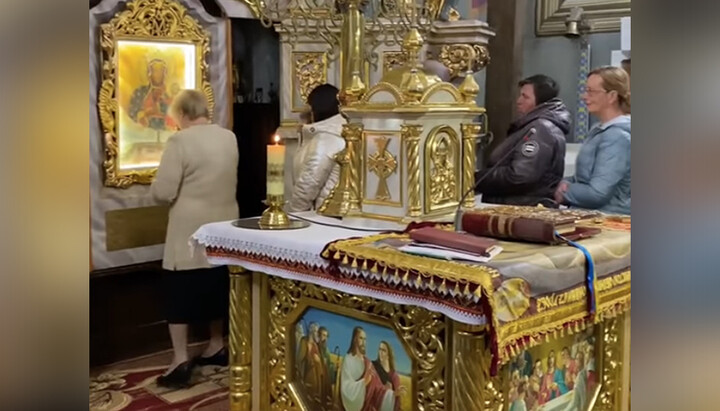
Parishioners in a Uniate church walk through the altar. Photo: screenshot from V. Kovtach's Facebook page
A video was published on the Web, where male parishioners and female parishioners pass through the altar of one of the Uniate churches to venerate the icon hanging behind the throne. All this is being watched by a bishop who looks like the Uniate Metropolitan of Ternopil-Zborov Vasyl Semeniuk.
Volodymyr Kovtach, who posted the video on his Facebook page, wrote "UGCC!" and quoted the 69th canon of the VI Ecumenical Council: “It is not permitted to a layman to enter the sanctuary (Holy Altar, Gk.).”
Earlier, the UOJ wrote that a pagan performance was staged in the Lviv temple of the UGCC.
Read also
Lithuanian bishop: Ukraine is no model for believers' rights
Vicar of Vilnius Diocese voices concern over attempts to import Ukraine's religious conflict into Lithuania.
Hundreds of believers honor St. Alexis of Carpatho-Russia in Khust Eparchy
At the St. Nicholas Monastery in the village of Iza-Karputlash, Metropolitan Mark of Khust led a festive liturgy, concelebrated by six metropolitans, five archbishops and three bishops.
Court upholds UOC parish appeal in Voloshky over OCU switch dispute
The Northern Commercial Court of Appeal has upheld the appeal of the St. Nicholas parish of the UOC in the village of Voloshky, Volyn region, in a dispute over a transfer to the OCU.
Zelensky says 9.5M Ukrainians expected to return home from abroad
Zelensky stated that 9.5 million Ukrainians who left abroad are expected to return home to rebuild the country.
German theologian criticizes Ukrainian authorities' pressure on UOC
German theologian Regina Elsner has said that pressure from the authorities on the Ukrainian Orthodox Church places an additional heavy burden on believers during the war.
Poland bans entry to Lviv official over SS Galicia and UPA glorification
Polish Foreign Minister initiates entry ban on Lviv Regional Council deputy who proposed declaring 2027 the Year of the UPA.