Lawyers: Phanar’s petition on Sophia to UN is a cover for own helplessness
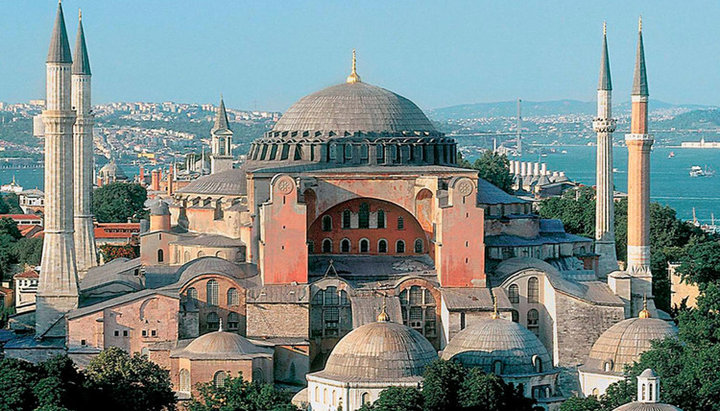
The Phanar’s petition regarding Hagia Sophia is not a legally binding action for the UN. Photo: i.pinimg.com
The petition, which is not a legally binding action for the UN, looks like an ineffective step to cover up its own helplessness or even unwillingness to work in this direction. This is stated in the commentary of the NGO "Public Advocacy" on the announced petition of the Patriarchate of Constantinople on the issue of Hagia Sophia at the UN.
Acknowledging the fact that Turkey has violated the "status quo" in relation to the Hagia Sophia Cathedral in Istanbul and that Orthodox Christians must take all measures to restore their rights, human rights defenders expressed perplexity that the Patriarchate of Constantinople has not taken any effective action in recent years to protect Orthodox communities in Turkey.
"Yes, one can observe occasional allegations of violations of the rights of structures of the Patriarchate of Constantinople, but there are no systematic actions, such as applying to the judicial system at the national level or the European Court of Human Rights," the organization notes. “It seems that the Patriarchate of Constantinople does not protect its rights in the structures that can give at least some result but constantly declares at the media and political level that its rights are violated, mainly in the U.S.A."
In particular, the NGO "Public Advocacy" does not understand why the structures of Constantinople did not make a single statement about the problems of Hagia Sophia during the session of the UN HRC which is currently meeting in Geneva, "especially since on September 28, 2020, the UN HRC considered the state of Turkey in the UN Universal Periodic Review procedure, and the Patriarchate of Constantinople, having a permanent office in Geneva, could raise this topic in the right place and under the correct protection procedure, because during this period Turkey's actions are assessed by diplomats from all over the world and it is in these procedures that it is easiest to attract the attention of the UN and advance the cause of protecting their rights”.
Also, human rights activists added, "the message in the UN procedure system that one of the structures created to protect the interests of the Patriarchate of Constantinople did not submit the text of its statement ‘due to lack of time’ is unclear”.
"This situation may well indicate that the Patriarchate of Constantinople began to perform some actions to protect its own interests in view of pressure from the public, its parishioners and patrons of art. Against this background, the creation of some ‘petition’, which is not only not a legally binding action for the UN, but is not even within the framework of any formalized legal procedure, looks like an ineffective step in advance to cover up its own helplessness or, worse still, unwillingness to work closely in this direction," the NGO "Public Advocacy" resumed.
As reported, on September 29, 2020, the Greek Orthodox Archdiocese of America stated that it was petitioning UN experts to hold Turkey responsible for its deliberate policy of destroying the cultural heritage of Orthodox Christians.
Read also
Met. Meletiy consecrates house of worship for UOC community in Dankivtsi
Members of the persecuted UOC Intercession parish in Dankivtsi have converted a house into a place for communal prayer and worship services.
OCU eparchy sells church center site to developer for housing
The OCU’s Volyn Eparchy sold land intended for a spiritual center to a private developer planning to build townhouses and residential buildings.
SBU names UOC priest’s wife a suspect in Cherkasy region
The SBU accused Matushka Kateryna Prykotenko of “spreading enemy propaganda” through correspondence with parishioners.
UGCC cleric calls Russian Orthodox literature dangerous for clergy
While examining the causes of divisions within the UGCC, Yustyn Boiko concluded that Russian Orthodox literature had influenced Greek Catholic clergy.
UOC will play major role in achieving peace, says Vadym Novynskyi
UOC Protodeacon Vadym Novynskyi believes the Church will help bring about reconciliation within Ukrainian society after the war ends.
Catholic media outraged by forcible conscription of Uniate cleric
The Vatican’s Apostolic Nunciature has demanded the return of a forcibly mobilized Greek Catholic cleric.