Know a man by his company, or Why we part ways with Patriarch Bartholomew
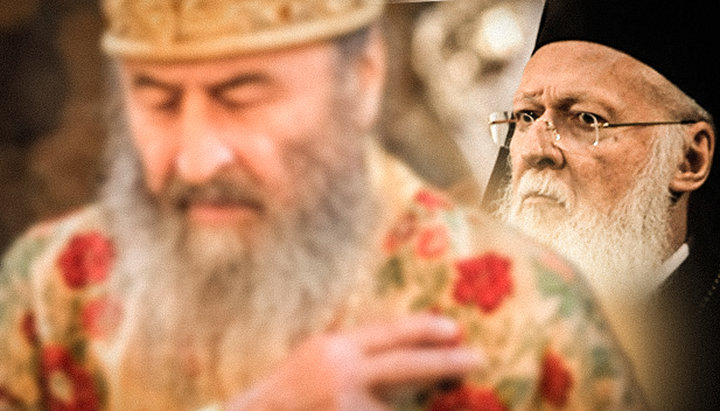
The head of Phanar "temporarily tolerates" His Beatitude Onuphry. Photo: UOJ
We know that we are children of God, and that the whole world is under the control of the evil one. (1 John 5:19)
Continuing to discuss the insulting statements of the Patriarch of Constantinople regarding the status of the UOC hierarchs and our Primate – His Beatitude Metropolitan Onuphry, whom Patriarch Bartholomew “temporarily tolerates” in Ukraine, I consider it important to pay attention to some circumstances.
Today, no one ever thinks to conceal that granting of the "Tomos" is a purely political project that has absolutely nothing to do with the benefit for the Church and the salvation of human souls. It was promoted and backed by the people who worship purely political things. There are certainly historical and canonical aspects in this project, designed to impart all processes a relative legitimacy, but often the ethical side of the problem is overlooked behind disputes about canons and history.
The ethics of the actions of the Patriarchate of Constantinople causes great bewilderment, and the statements of Patriarch Bartholomew appear as a consistent position that does not imply, to put it mildly, compliance with moral standards.
The statements of Patriarch Bartholomew appear as a consistent position that does not imply, to put it mildly, compliance with moral standards.
Therefore, it is easy to explain why a person regards members of the canonical Church as those who need to be “tolerated”, while at the same time claiming primacy in the entire Orthodox world. After all, the Phanar head seems not to bother at all that in the ethical sense primacy implies pastoral care, love and sacrifice, rather than a tolerant “dispensation” attitude towards something unpleasant but inevitable.
It is this peculiar, subjective ethical model of conduct that allows you to change your beliefs and positions. If Patriarch Bartholomew, who only some time ago recognized the Primate of the Ukrainian Orthodox Church, now treats him and his flock as “nothing”, then can His Holiness be considered a good shepherd? Actually, this conduct cannot be justified by any historical or canonical rationale. There can be no canonical justification for helping secular politicians to persecute the Church. If a person, who claims to be a global shepherd, behaves in this way, his claims look extremely implausible.
There can be no canonical justification for helping secular politicians to persecute the Church. If a person, who claims to be a global shepherd, behaves in this way, his claims look extremely implausible.
Quite recently, we have witnessed the ardent support by the Patriarchate of Constantinople for American politicians, whose ideological preferences fundamentally contradict the Orthodox faith. It is no secret that Joe Biden and Kamala Harris (candidate for the post of vice-president), whom Patriarch Bartholomew so enthusiastically greeted, are deservedly considered "the most pro-abortion candidates in history". Needless to say, Biden and Harris fervently support LGBT ideology, whose opponents are called "troglodytes" by Biden. Whether Biden considers his old friend Patriarch Bartholomew to be a "troglodyte" is a question.
Someone may notice that this is a conventional diplomatic formality – one has to live somehow, and in Istanbul the patriarchate is extremely vulnerable and needs the protection of the United States, which, by the way, could not (or did not want to) prevent the conversion of Hagia Sophia into a mosque. But even if one justifies such "loyal" diplomacy of a weak and defenseless Constantinople, then where did this ambitious "pan-Orthodox primacy" rhetoric come from?
I think this is not about forced cooperation based on fear and bribery. Here we can see sincere and voluntary cooperation, based on the coincidence of views and justified by a self-created ethical system.
Processes are taking place before our eyes, designed to create a new mentality, a new Orthodox identity. And if we agree with Patriarch Bartholomew in this, it means we will agree with his "friends" – with all the ideological movement that stands behind them. And the ideology and goals of this movement stand in sharp contrast with the Orthodox faith so much that trade-off with them is inappropriate not only for a pastor, but also for any Orthodox Christian. I believe that both in our and in the Greek Churches, people see this "remaking" of Orthodoxy.
Processes are taking place before our eyes, designed to create a new mentality, a new Orthodox identity. And if we agree with Patriarch Bartholomew in this, it means we will agree with his "friends" – with all the ideological movement that stands behind them.
Therefore, as strange as it may sound now, for me, as a bishop of the Ukrainian Orthodox Church, the words of the Primate of the Patriarchate of Constantinople about his "tolerance" towards me as a canonical bishop are a sign of a clear inconsistency in our ideological positions. At the same time, given his recent statements, one gets the impression that in pursuit of this desire to impose his vision on us and make us at least loyal, he is increasingly losing touch with reality. Alas, a person can bear the title of “His Divine All-Holiness” and, like other people, succumb to simple human temptations. Among the varied errors of this world, the Church is called to bear witness to the truth, rather than to be attached to the tail of the error that is hyped as most prospective.
In the Gospel, the Lord promises us that even “the gates of hell will not prevail against the Church,” but this does not mean that hell will not try to overcome the Church. I believe that the Church will survive the present trial, as She would overcome all heresies and schisms before. It may not be easy, not even immediately, but it will happen.
We must all pray fervently and seek wisdom and courage from God, Who has not forsaken and will not abandon His Church.
Read also
The Council of Crete: a decade of unity in name only
Constantinople marked the anniversary of the Council of Crete with a theological conference in France. They spoke about the unity of Orthodoxy, although over the past years there has noticeably been less of it.
Yelensky’s plan: Why is DESS demanding what the UOC has already done?
DESS is demanding that the UOC take steps it has already taken, while offering no assurance that further demands will not follow. What is behind Yelensky’s ultimatum?
Why OCU hierarchy lacks canonical ordination: what Local Churches say
The OCU head refuses to address invalidity of his ordinations. But almost all Local Churches speak of it – even those that recognized the OCU.
Why nation-first advocates do not call for peace
Ukraine’s population is declining by nearly one million people a year, and experts are warning of the nation’s demographic extinction. Yet the leaders of the Orthodox Church of Ukraine (OCU) and the Ukrainian Greek Catholic Church (UGCC) continue to call for war and mobilization.
The deception that decided the fate of the Tomos
In 2008, the "Filaret problem" derailed Yushchenko's plan. In 2018, Poroshenko solved it in just one hour – with a police escort for the Greeks and verbal promises to Filaret.
Lawyers in the crosshairs: How UOC is being stripped of its right to defense
Activists harass UOC lawyers outside courthouses, call them “traitors” on air, and promise them a “warm welcome” at hearings. The Church’s right to a legal defense is at stake.