Will MPs who do not vote to ban the UOC be hanged?
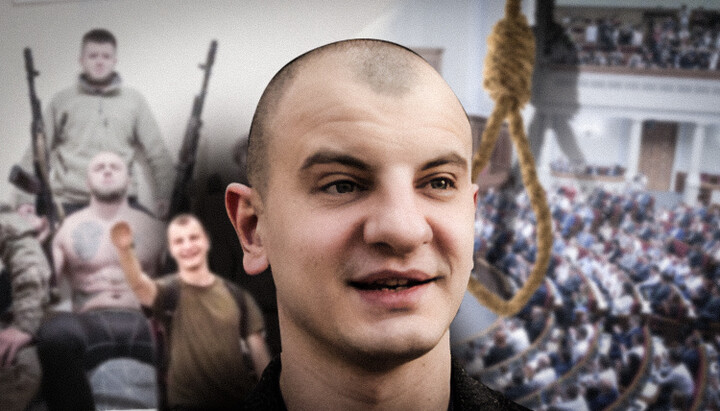
Are the authorities and radicals working in a bunch against the UOC? Photo: UOJ
In Ukraine, there is a strong pressure on those Members of Parliament who do not want to vote for the ban on the Ukrainian Orthodox Church (UOC). They are threatened with physical violence or even lynching.
It all began with a statement by the Speaker of Parliament, Ruslan Stefanchuk, who said that bills to ban the UOC are not being brought to the floor because there are not enough votes for them.
Ruslan Stefanchuk: "As long as there are not 226 votes for such an important legislative act, bringing it to the floor, failing it just to please the Russian Federation, is simply legally and politically irresponsible."
The media and radicals immediately responded to these words. The leader of C-14, Yevhen Karas, stated in his Telegram channel that he would "punch the face" of any MP who refuses to vote for the ban on the UOC.
"I may not reach everyone, of course. But I will set an example. The country will support it further," Karas said, demanding a list of MPs with specific names.
Interestingly, but Karas's words received a response at the highest level. One of the most consistent supporters of the OCU and opponents of the UOC in power, the head of the Parliament Committee on Humanitarian and Information Policy, Mykyta Poturaev, effectively called for providing Karas and his comrades with lists of MPs who would not want to vote for the UOC ban.
Mykyta Poturaev: "I have repeatedly said that without public pressure and media coverage, unfortunately, we will not be able to do this. That is, if it is necessary for the country to know specifically – who among the MPs is ready to vote (for the ban on the UOC – Ed.) even before the vote, and who is not ready, then I have repeatedly asked my media colleagues and colleagues from the public sector to clarify positions through phone calls."
Consequently, Poturaev urged journalists to call MPs and find out their position on the UOC. Why? To voice it in the media, create negative coverage, and, of course, incite radicals against them.
Karas personally suggested to his audience to hang MPs who are not willing to vote for the ban on the UOC. This post was read by nearly 150,000 people. Karas's like-minded individuals in the comments propose shooting, cutting, and castrating such deputies. For example, in support of Karas's initiative, one of the leaders of the radical organization "Tradition and Order," Christian Udarov, spoke out. Udarov stated that there will be "plenty" of people like him and Karas.
But who are Karas and Udarov, and can their threats be ignored in a war-torn country flooded with weapons?
Head of C-14, Yevhen Karas, has been known for organizing attacks on individuals he deems incorrect or insufficiently patriotic for many years. For example, in 2018, his C-14 group attacked a Romani camp in Kyiv. Karas has also organized actions near the Kyiv Pechersk Lavra.
Hromadsky’s journalists point out that the name C-14 is the first part of the Nazi code 14/88, where 14 is the number of words in the iconic phrase of the American racist David Lane, and 88 is the digital representation of the slogan “Heil Hitler”.
C-14 members have been labeled as Nazis by the international organization Bellingcat, as well as by publications such as The Washington Post, Reuters, and Radio Free Europe/Radio Liberty. Even the British Parliament has expressed concerns about Karas's actiions.
Nevertheless, Yevhen Karas is a prominent figure in Ukraine, appearing on major television channels, commanding a large audience, and wielding influence.
Even if he does not personally carry out acts of violence against MPs, he has many followers willing to carry out any of his directives.
Therefore, three questions arise:
- In a democratic country, can the government exert pressure on members of parliament to vote a certain way, especially in conjunction with those who threaten them with violence or harm?
- Will members of parliament vote freely and objectively after such threats?
- If the UOC is ultimately banned after such actions, can such a vote be considered legitimate?
We invite you to answer these questions independently.
Read also
Concubine or daughter? On words that cannot be used about the Church
An archon of the Church of Constantinople likened the UOC to Moscow’s “concubine.” But for St. Epiphanius of Cyprus, “concubines” are heresies.
Shameful chronicle of one week: how the OCU was born
Exarchs under escort, a call from the operations room, and 36 votes for Epifaniy: what a member of the Phanar delegation revealed about the 2018 "Council".
Can UOC eparchies be dissolved before court ruling on Metropolia?
DESS is launching separate proceedings against UOC eparchies, monasteries, and institutions while the case involving the Kyiv Metropolia is still pending.
Two murders, one silence
Zelensky condemned the killing of a Catholic priest in Poland the very same day. A month earlier, a UOC monk was murdered at the Sviatohirsk Lavra – and the president has remained silent ever since.
A bow to Phanar? Why did UOC academy congratulate Constantinople’s exarch?
A delegation from the Kyiv Theological Academy congratulated the Phanar’s exarch, who has remained silent about the persecution of the UOC. Who authorized this gesture, and why did even OCU supporters fail to appreciate it?
“De-Moscowize” for unity: Shevchuk’s recipe for bringing Ukrainians together
The head of the UGCC assures that internal division threatens the country's existence, while simultaneously calling to fight against the "wrong" ones. Is this cognitive dissonance or something more?