Ombudsman's Office: The rights of believers in the Lavra are not violated
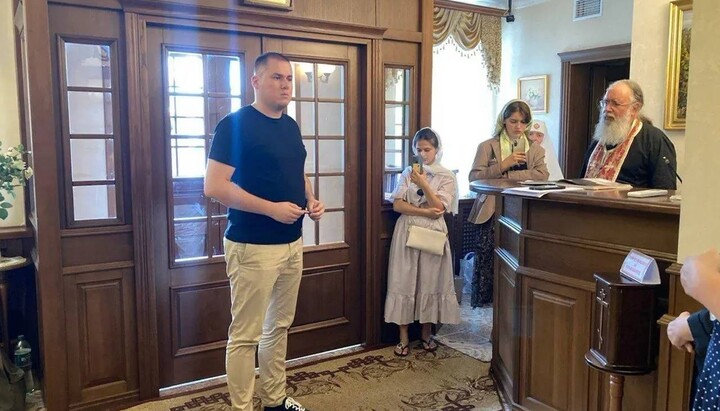
Representative of the Ombudsman Mykhailo Spasov in the Kyiv Pechersk Lavra. Photo: ombudsman.gov.ua
Mykhailo Spasov, a representative of the Verkhovna Rada Commissioner for Human Rights, has stated that the rights of monks and pilgrims who have been in the blocked buildings of the Kyiv Pechersk Lavra for over two months are not violated. This was stated in the official reply from Spasov to the lawyer of the monastery, Protodeacon Nikita Chekman, regarding violations of the rights of believers concerning life and freedom of movement and in connection with hunger strikes.
The document states that "individuals who are currently in buildings No. 57 and No. 58 have the opportunity to leave the premises freely, but they voluntarily stay inside the buildings and do not want to leave them." The Ombudsman's representative does not consider the argument that the administration of the National Reserve "Kyiv Pechersk Lavra" threatens not to let them back in if they leave the buildings to be valid. At the same time, the Lavra monks are officially registered in the monastery, and the cells they are in are their only housing.
Additionally, in Spasov's letter, it is stated that "there are currently no facts of hunger strikes," the residents of buildings No. 57 and No. 58 "have the opportunity to eat freely," they have food, and they "quench their thirst with tap water." Furthermore, the reserve's administration assured the Ombudsman's Office of the "absence of obstacles and prohibitions on the delivery of food." The Ombudsman's representative did not comment on the previously documented facts of hindrance in the delivery of food to the blocked buildings.
He also does not find the claims regarding the violation of the rights of UOC believers to freedom of religion justified. The official points out that parishioners and pilgrims of the Lavra have been given three churches (which are de facto outside the monastery), and that people can "participate in religious services through online broadcasts."
Additionally, Mykhailo Spasov reported that the Ministry of Internal Affairs and the National Police did not identify any violations in the actions of the police on the territory of the Lavra.
The letter suggests that the Ombudsman's Office also does not see violations of the rights of believers in the actions of the reserve when terminating the lease agreement with the monastery and sealing the monastery's buildings without a final court decision.
Protodeacon Nikita Chekman referred to the response from the Ombudsman's representative as a "form letter."
As previously reported, Mykhailo Spasov and his assistants visited the Kyiv Pechersk Lavra on September 1, 2023. After that, the Verkhovna Rada Commissioner for Human Rights, Dmytro Lubynets, stated in a television broadcast that violations of the rights of UOC believers in the Lavra were not established.
Read also
OCU activist admits breaking into UOC church in Sloviansk
Oleksandr Onyshchenko said that the OCU held its first "service" at the Seraphim Church, which had previously been broken into by forcing the locks and doors.
Archimandrite Ioustinos, longtime keeper of Jacob's Well, dies in Jordan
Archimandrite Ioustinos (Mamallos), the keeper of Jacob's Well in Nablus, has died after a prolonged illness.
Pilgrim group from Kyiv Theological Seminary visits Mount Athos
KTS students are making a pilgrimage to the holy sites of Romania, Greece, Mount Athos and Italy.
UOC cathedral celebrates its patronal feast in Ternopil
The service in the cathedral of the Holy Martyrs Faith, Hope, Love and their mother Sophia was led by Metropolitan Serhii of Ternopil, concelebrated by four hierarchs.
MinCulture marks centenary of Soviet-era reserve at Lavra's Refectory Church
Representatives of the Ministry of Culture presented awards to the Reserve's employees on the occasion of the anniversary at the Refectory Church of the Lavra.
Conference to mark 1700th anniversary of Christianity adoption held in Georgia
In Georgia, representatives of the Church and the state noted the defining role of Christianity in the country's cultural development.