US media: Repressions of UOC provoke violence & undermine trust in govt
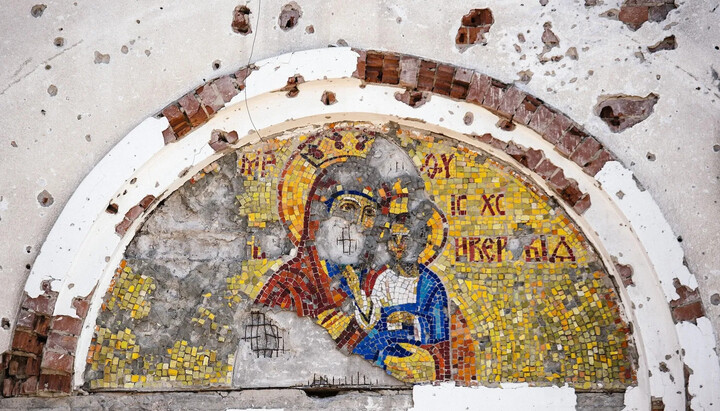
A ruined mosaic. Photo: foreignpolicy.com
The US journal Foreign Policy has published the article "Ukraine Has a Civil Rights Problem" by Nicolai N. Petro, a professor of political science at the University of Rhode Island, where the author criticised the actions of the Ukrainian authorities towards citizens.
The article notes that the UOC, one of the country's largest (Christian) denominations, is being repressed by the government. The Ukrainian government views the Church as an agent of Russian influence, even though the UOC broke administrative ties with the Russian Orthodox Church in 1990 and ceased all formal canonical ties with it in May 2022.
"Despite this, property, assets and shrines were seized years before the full-scale Russian invasion began, and clergy are being prosecuted for crimes against the state – many cases on trumped-up charges. In October 2023, Ukraine's parliament took the first step towards a complete ban on the Church by approving a bill that bans religious groups 'associated with centres of influence ...> located outside Ukraine, in a country carrying out military aggression against Ukraine'," the article says.
The political analyst writes that the main lobbyist of such a policy towards the UOC was the OCU, which was created as a "nationalist alternative to the UOC", and also calls the initiative of the Ministry of Culture to rename the UOC to the Russian Orthodox Church in Ukraine an unsuccessful attempt to provoke a mass transition of parishioners to the OCU.
"Many have noted the legal, ethical and theological problems associated with these moves. Surprisingly few, however, are concerned about the internal political turmoil they may unleash. Portraying the UOC as an illegal and hostile religious organisation risks provoking violence against the Church and its members. Andriy Baumeister, a professor at Kyiv University, suggested that increasing religious hostility at a time when the country so desperately needs unity could further undermine public confidence in the government, creating a slowly simmering 'legitimacy deficit' that could explode in five or even 10 years," the article's author emphasised.
As reported, earlier American journalist Michael Brendan Dougherty expressed the opinion that in the UOC case, there is an idea of collective religious guilt in Ukraine.
Read also
Archimandrite Ioustinos, longtime keeper of Jacob's Well, dies in Jordan
Archimandrite Ioustinos (Mamallos), the keeper of Jacob's Well in Nablus, has died after a prolonged illness.
Pilgrim group from Kyiv Theological Seminary visits Mount Athos
KTS students are making a pilgrimage to the holy sites of Romania, Greece, Mount Athos and Italy.
UOC cathedral celebrates its patronal feast in Ternopil
The service in the cathedral of the Holy Martyrs Faith, Hope, Love and their mother Sophia was led by Metropolitan Serhii of Ternopil, concelebrated by four hierarchs.
MinCulture marks centenary of Soviet-era reserve at Lavra's Refectory Church
Representatives of the Ministry of Culture presented awards to the Reserve's employees on the occasion of the anniversary at the Refectory Church of the Lavra.
Conference to mark 1700th anniversary of Christianity adoption held in Georgia
In Georgia, representatives of the Church and the state noted the defining role of Christianity in the country's cultural development.
MP urges to ease pressure on UOC for sake of peace
Oleksii Honcharenko proposed compromises on language, historical memory, and Church issues as part of efforts to achieve peace, saying those who wish to attend the “Russian Church” should be allowed to do so.