Greek theologian explains if UOC clerics should commemorate ROC Patriarch
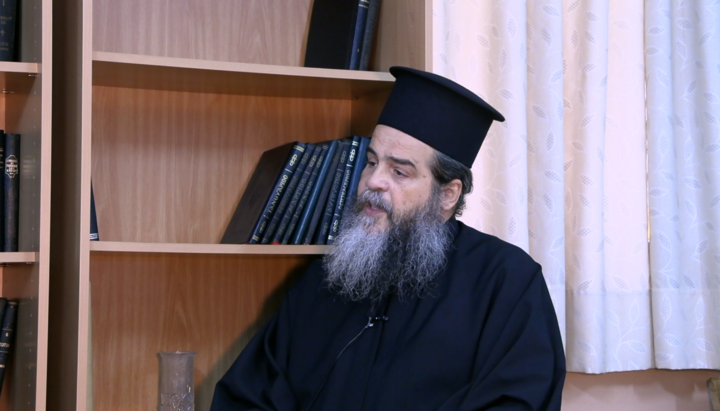
Greek theologian Anastasios Gotsopoulos. Photo: UOJ
Greek theologian and cleric of the Patras Metropolis of the Greek Church, Presbyter Anastasios Gotsopoulos, in an interview with the UOJ, explained how to understand the 15th Canon of the First-Second Council, which prescribes that priests should commemorate the Patriarch.
The theologian explained that the Patriarch has a dual role. On the one hand, he is the ruling bishop of a certain eparchy, and on the other hand, he is the head of a group of eparchies forming the Local Church.
Taking the Patriarchs of the Constantinopolitan and Alexandrian Churches as examples, the presbyter explained that priests in parishes are obligated to commemorate them during services only if their churches are located in Constantinople or Alexandria.
"For example, parishes in the city of Alexandria commemorate their bishop – Patriarch Theodore. But what happens, for example, in the Congo, where there is a local bishop? Or whom do priests in Kananga commemorate? They commemorate the Metropolitan of Kananga. The Metropolitan of Kananga commemorates the Patriarch of Alexandria. But priests in the city of Alexandria do not commemorate any other bishop. Their bishop is Patriarch Theodore, and that is why they commemorate him directly," the theologian said.
According to him, when the 15th Canon declares that a priest should commemorate his Patriarch, it is implied that this priest serves where the Patriarch is his ruling bishop.
"For example, in the city of Antioch, such a bishop is the Patriarch of Antioch, in the city of Constantinople – the Patriarch of Constantinople, in Alexandria – the Patriarch of Alexandria. In Moscow, priests commemorate the Patriarch of Moscow as their ruling bishop," said Fr Anastasios.
Speaking about Ukraine, he emphasized that it has its own Primate.
"There, a parish priest will commemorate his bishop, and the bishop of each city commemorates Metropolitan Onuphrius of Kyiv. And Metropolitan Onuphrius commemorates the Patriarch of Moscow, with whom there is canonical communion," the theologian said.
When asked how he would comment on statements by some ROC representatives that UOC believers cannot partake if Patriarch Kirill is not commemorated in their parishes, Fr Anastasios said that he does not understand such logic.
"I am not aware of such a practice; I do not know why they say that. As far as I know, in all other Local Churches: Constantinople, Antioch, Alexandria, Serbia, Romania, Greece, Australia, etc., a parish priest commemorates only his bishop. Only him. And the bishop commemorates the Patriarch. Thus, I do not see any problem with any parish priest in Ukraine commemorating only his ruling hierarch," said the Greek theologian.
Read also
Upper Lavra court hearing postponed
The next court hearing in the Upper Lavra case has been scheduled for November 3.
UOC priest blesses ambulances at Kamianske medical center
A UOC priest in Kamianske blessed ambulances for a medical facility and wished its doctors God's help in their work.
Dumenko to German ambassador: Law targeting UOC also applies to other groups
Epifaniy Dumenko sought to defend Ukraine’s law restricting religious organizations during a meeting with the German ambassador.
Activists bused to court hearings in UOC cases, media say
A minibus has been spotted transporting protesters to and from courthouses where UOC cases are being heard.
Firefighters save historic UOC church from fire in Zakarpattia
A fire broke out at a UOC church in the Tiachiv district, damaging the altar and church furnishings.
Volyn Eparchy faithful collect six tons of aid for Sviatohirsk Lavra
Believers in Volyn collected food and warm clothing for people displaced by the war who have found shelter at Sviatohirsk Lavra.