KDAiS rector: St Niсodemus of Holy Mount denies Phanar’s eccumenical power
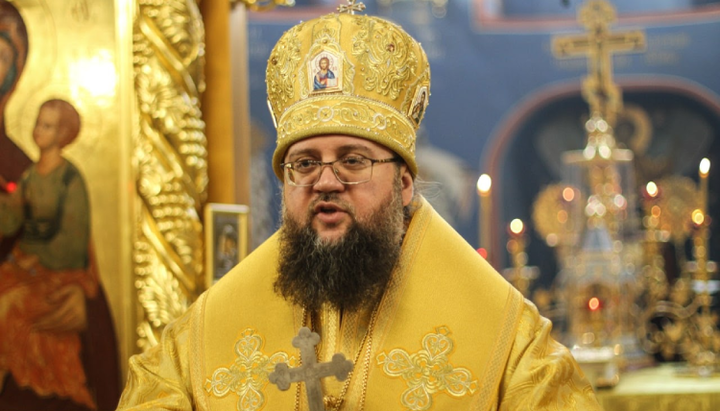
Bishop Sylvester of Belogorodka (Stoychev). Photo: kdais.kiev.ua
St. Niсodemus of the Holy Mount in his book "Pedalion", which can be considered the official canonical collection of the Greek Church, gave the correct interpretation of Canon 9 of the IV Ecumenical Council, which refutes the opinion of the Patriarchate of Constantinople and some hierarchs of the Greek Church about the right of the head of the Phanar to receive appeals from bishops and clergy that are not under its jurisdiction. This is stated in the report "St. Niсodemus of the Holy Mount and his thoughts on the judicial powers of the Patriarch of Constantinople" by the rector of the Kyiv Theological Academy and Seminary (KDAiS), Bishop Sylvester (Stoychev) of Belogorodka, writes the KDAiS website.
The document says that today the official point of view of the Patriarchate of Constantinople boils down to the fact that the Ecumenical Patriarch (and he only) has the right to receive appeals from convicted clergy of all Local Orthodox Churches, to revise court sentences adopted in other Local Churches and to issue unappealable decisions in these cases. Based on this understanding of his rights, Patriarch Bartholomew accepted the appeal of the former Metropolitan Philaret (Denisenko) of Kyiv excommunicated by the Council of Bishops of the Russian Orthodox Church in 1997, and the Holy Synod lifted the anathema from him and reinstated him in the episcopal rank. Then Phanar accepted into communion all the members of the UOC-KP and the UAOC.
St. Nicodemus reminds of the general principle of canon law that prohibits bishops, metropolitans and patriarchs to act outside their ecclesiastical regions. If we admit the possibility of an appeal to Constantinople against the decisions of other patriarchs, then this clearly contradicts this principle.
In addition, St. Nicodemus refers to the legislation of the Byzantine emperors, in which one can see a certain interpretation of the church canons. In particular, he refers to the 123rd lege (law) of Emperor Justinian. Chapter 22 of this Novellae speaks about the ecclesiastical legal proceedings and can serve as an interpretation to the 9th canon of the IV Ecumenical Council. This chapter says that in the event of a disagreement between the bishops, their case should be considered by the metropolitan standing above them with two bishops from the same area. If the parties do not agree with the decision of such a court, then they can turn to the patriarch of “that diocese”. After the patriarch renders his verdict, "none of the parties has the right to appeal against his decision".
Thus, according to Byzantine law, every patriarch makes judgments that cannot be appealed. Therefore, the Patriarch of Constantinople could not accept appeals against the decisions of other patriarchs.
As reported, the heresy of papism of the head of the Phanar should be condemned in a conciliar manner, says Athanasios Zoitakis, a specialist in the history of the Church and the history of Greece.
Read also
Met. Meletiy consecrates house of worship for UOC community in Dankivtsi
Members of the persecuted UOC Intercession parish in Dankivtsi have converted a house into a place for communal prayer and worship services.
OCU eparchy sells church center site to developer for housing
The OCU’s Volyn Eparchy sold land intended for a spiritual center to a private developer planning to build townhouses and residential buildings.
SBU names UOC priest’s wife a suspect in Cherkasy region
The SBU accused Matushka Kateryna Prykotenko of “spreading enemy propaganda” through correspondence with parishioners.
UGCC cleric calls Russian Orthodox literature dangerous for clergy
While examining the causes of divisions within the UGCC, Yustyn Boiko concluded that Russian Orthodox literature had influenced Greek Catholic clergy.
UOC will play major role in achieving peace, says Vadym Novynskyi
UOC Protodeacon Vadym Novynskyi believes the Church will help bring about reconciliation within Ukrainian society after the war ends.
Catholic media outraged by forcible conscription of Uniate cleric
The Vatican’s Apostolic Nunciature has demanded the return of a forcibly mobilized Greek Catholic cleric.