Phanar favours calendar reform and joint Easter with RCC
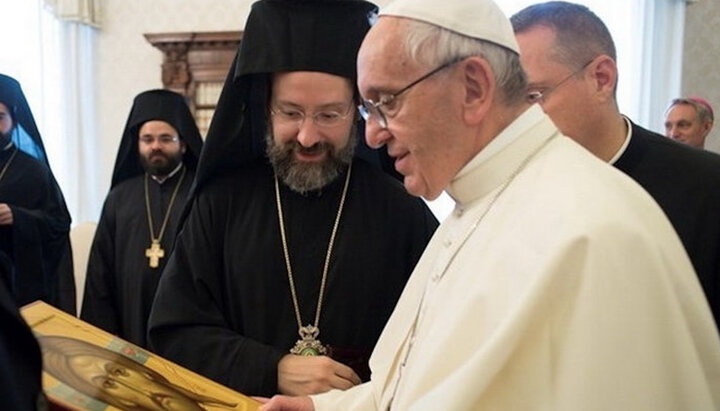
Archbishop Job (Getcha) and Pope Francis. Photo: incarnatewordsistershouston.org
The representative of the Patriarchate of Constantinople, Archbishop Job (Getcha) of Telmessos, said that the Phanar is ready for calendar reform and joint Easter "with various Christian churches".
He noted that on the occasion of the 1700th anniversary of the First Ecumenical Council held in Nicaea in 325, the World Council of Churches plans to organize a Commission for the World Conference of the Faith and Order Commission “in order to celebrate this anniversary and to reflect on the transmission of the apostolic faith today”. “ The purpose of this conference will not be to study the history of the council nor to study its theology, but rather to reflect on what ‘visible unity’ means today to different Christian Churches and how Christians can collectively promote, preach and live the apostolic faith today,” the Phanar spokesman said.
He recalled that "the Council of Nicaea did not only promulgate the Creed that ought to become universal but also ensured a common celebration of Easter for the entire Christendom ", which, in his opinion, was a manifestation of "unity in faith".
Talking about the difference in the celebration of the Easter date between Orthodox and Western Christians, Archbishop Job recalled that “the question of the revision of the calendar and the common date of Easter was raised in the Orthodox Church on several occasions during the 20th century” and “the calendar reform was subsequently discussed at the Pan-Orthodox Congress of Constantinople of 1923, convened by Patriarch Meletios IV of Constantinople, which led to a partial revision of the calendar."
However, the Phanar spokesman noted, "facing the reluctance of some Orthodox to adopt the ‘Roman Catholic’ Gregorian calendar, a Serbian astronomer, Milutin Milankovic, proposed a revised Julian calendar".
According to Archbishop Job, “the question of the calendar and the common date of Pascha was listed among the 17 topics to be examined by the future Holy and Great Council of the Orthodox Church,” however, “the Synaxis of the Primates of the Orthodox Churches held in Chambésy in January 2016, decided to exclude this question from the agenda of the council, fearing that a calendar reform would create a new schism within the Orthodox Church".
“Perhaps, the celebration of the 1700th anniversary of the council of Nicaea in 2025 would be a good occasion to educate Christians on the necessity of a calendar reform and of a common date of Pascha in order to remain truly faithful to the decisions of the First Ecumenical Council,” the Phanar hierarch emphasized, and “ The fact that the Eastern and Western dates of Easter will coincide on that year should be taken as an encouragement towards that direction,” he resumed.
Earlier, the UOJ wrote that the Roman Catholic Church welcomes the Phanar's idea of a joint celebration of Easter by 2025.
Read also
Khust Eparchy honors memory of St. Job of Uholka
A Liturgy is served in Mala Uholka, a birthplace of St. Job of Uholka, on the saint's feast day.
UOC parish in Cologne donates ultrasound machine to Kharkiv region hospital
In Cologne, UOC believers raised funds for an ultrasound machine for the Kehychivka district hospital in the Kharkiv region.
Shevchuk tells Pope Leo of Ukraine's preparations for "another harsh winter"
The head of the UGCC expressed "special gratitude" to the Pope for his phone calls with Putin and Zelensky.
Berlin hierarch comments on Phanar document published by UOJ-USA
Metropolitan Mark called the information about the 2018 "Unification Council" alarming if confirmed, and expressed hope that Patriarch Bartholomew will reconsider his position.
UOC marks Synaxis of All Saints of Volyn Land at Lutsk cathedral
Metropolitan Serhiy of Ternopil and Kremenets led the Liturgy on the feast day of the Lutsk cathedral of All Saints of the Volyn Land.
SBU detains OCU cleric who organized draft evader's escape for money
In Transcarpathia, law enforcement officers detained a clergyman of the OCU who arranged for a draft evader to be smuggled into Slovakia for $15,000.