UOC can be banned based on Russian documents
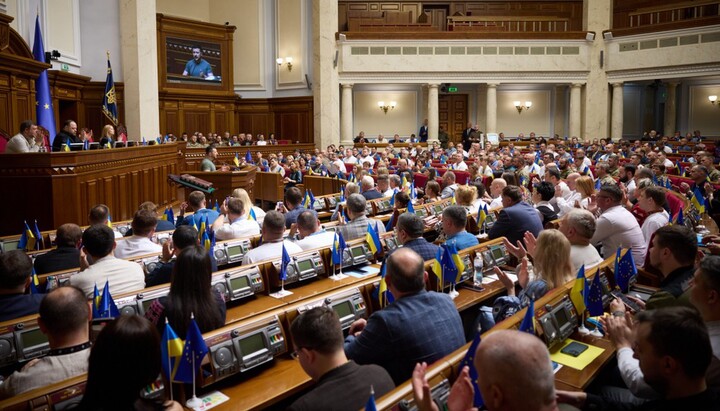
The Verkhovna Rada. Photo: RBC
The bill 8371 in the new edition, recommended by the Committee of the Council for adoption in the second reading, contains provisions according to which the UOC can be banned based on the statutory documents of the Russian Federation structures.
The UOJ has a table with changes in the bill at its disposal.
In particular, the document (Article 3.1) states that "the activity of the ROC on the territory of Ukraine is prohibited."
Article 5 states that the activities of a religious organization are not allowed if it is affiliated with a foreign religious organization (association) whose activity is prohibited in accordance with Article 3 of the Law of Ukraine "On the Protection of National and Public Security, Rights and Freedoms of Man in the Sphere of Activities of Religious Organizations."
As such affiliation, it is indicated that:
- in official documents and/or decisions of management bodies, and/or in the charter (regulation) of the foreign religious organization (association) whose activity is prohibited... there are indications of the inclusion of a religious organization (association) operating in Ukraine in its structure or provisions on the right of the statutory management bodies of the specified foreign religious organization (association) to make decisions on canonical and organizational issues that are binding for the religious organization (association) operating on the territory of Ukraine (paragraph 3);
- official documents and/or decisions of management bodies and/or the charter (regulation) of the foreign religious organization (association) whose activity is prohibited... provide for the mandatory inclusion of leaders and/or authorized representatives of a religious organization (association) operating in Ukraine in the statutory management bodies of the specified foreign religious organization (association).
In addition, in the new edition of the law, it is stated that the activities of a religious organization (community – Ed.) cease if it is caught in the propaganda of the "Russian world".
"When applying this norm, the facts of spreading the propaganda of the ideology of the Russian world as directly by the religious organization (association) itself, as well as by its statutory or other management bodies, other persons acting on their behalf, on the instructions or with the permission or in accordance with another method of coordination, regardless of the form of such coordination," it is said in the new edition of the bill 8371.
At the same time, to prove the facts of "propaganda of the Russian world", the state can use "conclusions of religious studies expertise", "information received from individuals and legal entities, from the media and other open sources."
Earlier, the UOJ wrote that the Verkhovna Rada Committee Rada approved the bill on the UOC for adoption in the second reading.
Read also
UOC cathedral celebrates its patronal feast in Ternopil
The service in the cathedral of the Holy Martyrs Faith, Hope, Love and their mother Sophia was led by Metropolitan Serhii of Ternopil, concelebrated by four hierarchs.
MinCulture marks centenary of Soviet-era reserve at Lavra's Refectory Church
Representatives of the Ministry of Culture presented awards to the Reserve's employees on the occasion of the anniversary at the Refectory Church of the Lavra.
Conference to mark 1700th anniversary of Christianity adoption held in Georgia
In Georgia, representatives of the Church and the state noted the defining role of Christianity in the country's cultural development.
MP urges to ease pressure on UOC for sake of peace
Oleksii Honcharenko proposed compromises on language, historical memory, and Church issues as part of efforts to achieve peace, saying those who wish to attend the “Russian Church” should be allowed to do so.
Court takes 17th-century church in Staryi Pochaiv from UOC community
A commercial court overturned a 2018 registrar’s decision and stripped the UOC’s Ternopil Eparchy of ownership of the 17th-century church.
Vinnytsia Eparchy honors Bar Icon of the Mother of God
Metropolitan Varsonofiy celebrated the Liturgy at the Bar Convent on the feast day of the wonderworking icon of the Mother of God.