Kovalenko spreads fake news on creation of UOC Russian propaganda network
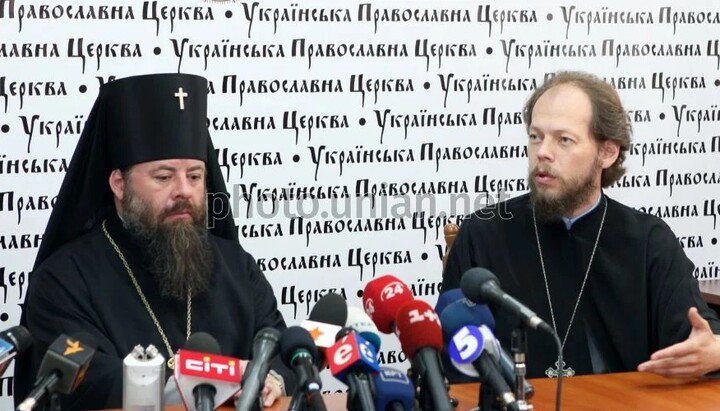
Vladyka Mitrofan (now deceased), head of the DECR UOC, and Fr. Georgiy Kovalenko, former press secretary of the UOC. Press conference of the UOC. Photo: UNIAN
Georgiy Kovalenko, a former priest of the Ukrainian Orthodox Church who switched to the OCU several years ago, stated in an interview with the channel "We Are Ukraine" that UOC parishes abroad are actually engaged in promoting "pro-Russian narratives" in Europe. He accused the deputy head of the Department for External Church Relations of the UOC, Archpriest Mykolay Danylevych, of coordinating this process.
"After the start of the full-scale invasion in May 2022, the UOC-MP at its council decided to create a network of overseas parishes. That is, in this way, it actually began to transfer part of the influence that the Moscow Patriarchate had previously exerted through Russian parishes and embassies," said the former UOC cleric.
According to him, these are now "a factual network of allegedly Ukrainian parishes, allegedly people with Ukrainian passports."
"Unfortunately, the narratives being spread, including in Europe, are narratives that are akin to Russian propaganda, such as persecution of believers in Ukraine, that there is a civil war here, and so on," Kovalenko said.
Georgiy Kovalenko once headed the Information Department of the UOC and was in the neighboring office to Father Nikolay Danylevych. It should be noted that as representatives of Synodal departments, they frequently prepared and participated in joint church events and briefings.
"So, this is a complex system that has been built up over the years, and now citizens of Ukraine have joined it. And Mykolay Danylevych is precisely the person who coordinated this activity," he now says about his former colleague.
As reported by the UOJ, German Catholic professors have expressed their support for Fr Mykolay Danylevych.
Bremer and Elsner, among other things, pointed out that Father Mykolay is responsible for the pastoral care of Ukrainian Orthodox refugees in Western Europe and is involved in establishing parish structures of the UOC in European countries. Based on their experience, they called these parishes "an important spiritual and humanitarian anchor for many refugees."
"They are largely publicly open and in contact with humanitarian and church institutions in Germany, and they pose no security risk to Ukrainian refugees and European societies. On the contrary, these parishes enrich the religious landscape in Europe and provide a safe space for Ukrainian Orthodox believers who do not want to attend other Orthodox parishes, primarily those belonging to the Moscow Patriarchate," their statement reads.
Earlier, it was reported that the SBU handed a suspicion to the deputy head of the DECR UOC, Archpriest Mykolay, under two articles of the Criminal Code of Ukraine. In particular, the SBU's statement says that Archpriest Mykolay headed the UOC's overseas dioceses and, under the guise of spiritual care for refugees, propagated Russian narratives to them.
Read also
Upper Lavra court hearing postponed
The next court hearing in the Upper Lavra case has been scheduled for November 3.
UOC priest blesses ambulances at Kamianske medical center
A UOC priest in Kamianske blessed ambulances for a medical facility and wished its doctors God's help in their work.
Dumenko to German ambassador: Law targeting UOC also applies to other groups
Epifaniy Dumenko sought to defend Ukraine’s law restricting religious organizations during a meeting with the German ambassador.
Activists bused to court hearings in UOC cases, media say
A minibus has been spotted transporting protesters to and from courthouses where UOC cases are being heard.
Firefighters save historic UOC church from fire in Zakarpattia
A fire broke out at a UOC church in the Tiachiv district, damaging the altar and church furnishings.
Volyn Eparchy faithful collect six tons of aid for Sviatohirsk Lavra
Believers in Volyn collected food and warm clothing for people displaced by the war who have found shelter at Sviatohirsk Lavra.