UOC Law Dept. comments on Supreme Court’s decision on so-called "transfers"
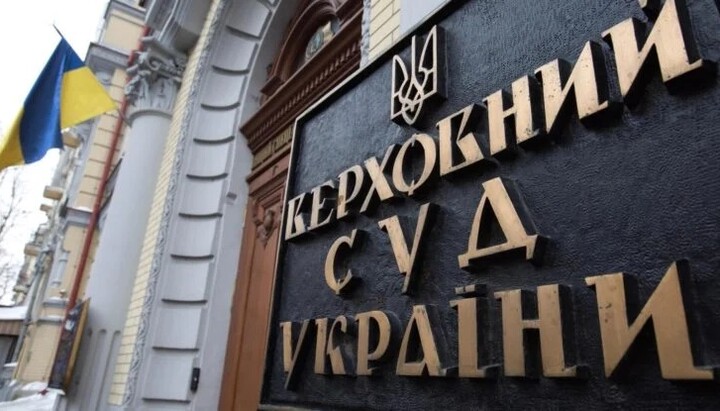
The Supreme Court of Ukraine. Photo: glavnoe.in.ua
Numerous publications with resonating headlines such as "Legalisation of the transition of a religious community from the UOC-MP to the OCU by the Supreme Court of Ukraine on 03.04.2024" and "Court for the first time recognizes as legal transition of a religious community" are being circulated in various online media outlets and social networks. With the aim of putting an end to manipulations regarding the decision of the Supreme Court of Ukraine concerning the Intercession religious community of the UOC in the village of Kalynivka, Zhytomyr region, the Legal Department of the Ukrainian Orthodox Church has prepared a commentary on this matter, reports the UOC Information and Education Department.
The first thing the Legal Department pays attention to is that according to Ukrainian legislation, in particular Article 8 of the Law of Ukraine "On Freedom of Conscience and Religious Organisations", the state already recognises the right of a religious community to freely change its subordination by making corresponding changes to the statute (regulations) of the religious community.
"The right to change the subordination of any religious organisation is regulated by law and does not need any 'legalisation' or 'legitimisation by the court'," the commentary says. "Consequently, the claim that allegedly the Supreme Court of Ukraine has 'legalised' etc. the transfer of a religious community to the Ukrainian Orthodox Church is another attempt to manipulate public opinion."
According to UOC lawyers, the only issue that the court actually resolved is that decisions regarding changes in subordination may violate the right of the leader of the religious community, as it concerns his right to freedom of religion.
"Referring to the decision of the Grand Chamber of the Supreme Court dated 3 April 2024, in the context that it resolved all disputed or unsettled issues for all other cases on the same issues is not true, because the court considers each dispute on the basis of specific circumstances of the case, confirmed by relevant evidence, and cannot be limited by any court decisions or the position of courts of different instances, including the Supreme Court of Ukraine," said the Legal Department.
The lawyers draw attention to the fact that any actions regarding the general meeting of a religious community, decision-making on the change of subordination and introduction of relevant changes or amendments to the statute, must be taken within the limits and in the ways established by the legislation of Ukraine.
"Cases where outsiders, unrelated to the respective religious community, acting in their own interests or the interests of third parties, convene an unlawful general meeting and make decisions on behalf of all members of the religious community in no way justify or are recognised as legitimate by the decision of the Grand Chamber of the Supreme Court dated 3 April 2024, and accordingly, should be considered and evaluated by the court for each case separately," added the Synodal Department of the UOC.
As reported by the UOJ, on 3 April, the Supreme Court of Ukraine considered the case of the Intercession religious community of the UOC in the village of Kalynivka, Zhytomyr region, where the UOC parish was "transferred" to the OCU in 2019.
Read also
Khust Eparchy honors memory of St. Job of Uholka
A Liturgy is served in Mala Uholka, a birthplace of St. Job of Uholka, on the saint's feast day.
UOC parish in Cologne donates ultrasound machine to Kharkiv region hospital
In Cologne, UOC believers raised funds for an ultrasound machine for the Kehychivka district hospital in the Kharkiv region.
Shevchuk tells Pope Leo of Ukraine's preparations for "another harsh winter"
The head of the UGCC expressed "special gratitude" to the Pope for his phone calls with Putin and Zelensky.
Berlin hierarch comments on Phanar document published by UOJ-USA
Metropolitan Mark called the information about the 2018 "Unification Council" alarming if confirmed, and expressed hope that Patriarch Bartholomew will reconsider his position.
UOC marks Synaxis of All Saints of Volyn Land at Lutsk cathedral
Metropolitan Serhiy of Ternopil and Kremenets led the Liturgy on the feast day of the Lutsk cathedral of All Saints of the Volyn Land.
SBU detains OCU cleric who organized draft evader's escape for money
In Transcarpathia, law enforcement officers detained a clergyman of the OCU who arranged for a draft evader to be smuggled into Slovakia for $15,000.