Orthodox Church celebrates the bright Resurrection of Christ
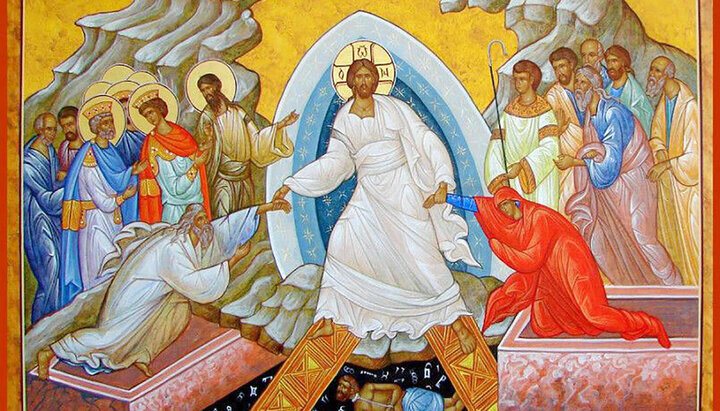
Resurrection of Christ. Photo: stsl.ru
On May 5, 2024, the Orthodox Church celebrates the main holiday of the entire church year, the spiritual center of the Orthodox calendar, the Feast of the Resurrection of Christ.
Pascha is a movable feast, its date changes every year and depends on the lunar-solar calendar.
The holiday does not belong to the twelve major feasts but stands as if above their circle because its significance is truly unique.
On Pascha, we remember the events described in the New Testament by all four evangelists – Matthew, Mark, Luke, and John. The four Gospels tell of the days of Holy Week and the Resurrection of Christ.
On Good Friday of Holy Week, the Savior was crucified on the cross. His disciples buried Him in a cave located near Golgotha, the hill where executions – crucifixions – took place.
On the night from Saturday to Sunday, the eve of the Jewish Passover, Mary Magdalene and other women came to the cave to wash and anoint with fragrances the body of the crucified Christ. These women are traditionally called the Myrrh-bearing Women in the Church.
The faithful disciples discovered that the stone covering the entrance to the cave was rolled away, and the tomb itself was empty. Two Angels appeared to them and announced the Resurrection of Christ: "And it came to pass, as they were much perplexed thereabout, behold, two men stood by them in shining garments: And as they were afraid, and bowed down their faces to the earth, they said unto them, Why seek ye the living among the dead?" (Luke 24:4-5).
The Resurrection of Christ is the spiritual center of all Christianity. The Apostle Paul wrote in his First Epistle to the Corinthians: "But if there be no resurrection of the dead, then is Christ not risen: And if Christ be not risen, then is our preaching vain, and your faith is also vain" (1 Corinthians 15:13-14).
The word "Pascha" literally translates as "passover, passing by, liberation." In Hebrew, Pascha is: פסח (Pesaḥ). In Greek: πάσχα. In Latin: Pascha.
The feast of the Resurrection of Christ received the name "Pascha" from the Jewish festival of Passover. Passover among the Jews is dedicated to the Exodus of the Israelites from Egypt and their liberation from slavery. These events are described in the Old Testament.
Why did Christians take the name of the Jewish holiday? The events of Holy Week - the betrayal of Judas, the arrest of Christ, the Passion of Christ, and the crucifixion - occurred on the eve of the Jewish Passover. And the Resurrection of Christ - on the night of Passover.
As previously reported by the UOJ, on May 4, 2024, at 14:14 Kyiv time, the Holy Fire descended in the Church of the Resurrection of Christ above the Holy Sepulcher in Jerusalem.
Read also
Khust Eparchy marks memory of St. Job of Uholka
В селе Мала Уголька, на родине Иова Угольского, отслужили литургию в день памяти святого подвижника.
UOC parish in Cologne donates ultrasound machine to Kharkiv region hospital
In Cologne, UOC believers raised funds for an ultrasound machine for the Kehychivka district hospital in the Kharkiv region.
Shevchuk tells Pope Leo of Ukraine's preparations for "another harsh winter"
The head of the UGCC expressed "special gratitude" to the Pope for his phone calls with Putin and Zelensky.
Berlin hierarch comments on Phanar document published by UOJ-USA
Metropolitan Mark called the information about the 2018 "Unification Council" alarming if confirmed, and expressed hope that Patriarch Bartholomew will reconsider his position.
UOC marks Synaxis of All Saints of Volyn Land at Lutsk cathedral
Metropolitan Serhiy of Ternopil and Kremenets led the Liturgy on the feast day of the Lutsk cathedral of All Saints of the Volyn Land.
SBU detains OCU cleric who organized draft evader's escape for money
In Transcarpathia, law enforcement officers detained a clergyman of the OCU who arranged for a draft evader to be smuggled into Slovakia for $15,000.