What is the superiority of the Myrrh-bearing women over the apostles?
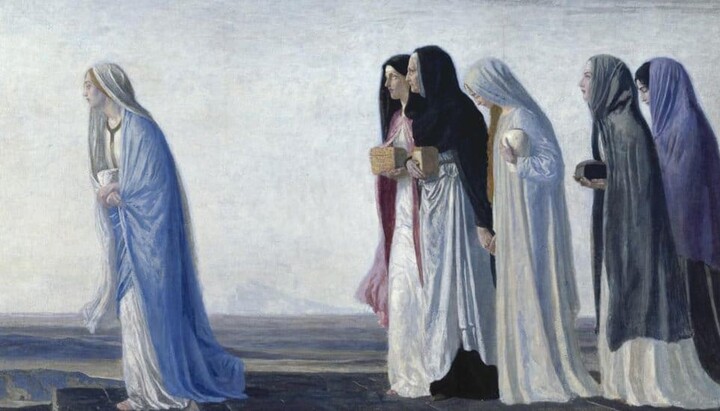
The Myrrh-bearing women. Photo: Foma
A week after the apostle Thomas was convinced of the truth of Christ’s Resurrection, we remember the Myrrh-bearing women, who were not interested in theological questions. At least, the Gospel does not mention that the women who followed Christ asked Him any questions.
At a time when the apostles could barely hide their disappointment in the Messiah, who "allowed" Himself to be killed, the Myrrh-bearing women continued to serve Christ after His crucifixion. Even when the Saviour predicted His death to the apostles, they continued to argue about who among them was the greatest. The holy women did not ask anything. They were simply always there, doing everything they could to ease Christ’s path on earth.
After the Saviour’s crucifixion, the apostles scattered in different directions and hid, abandoning their Teacher. Meanwhile, the faith of the Myrrh-bearing women was able to withstand this trial. For them, unconditional devotion and heartfelt emotions were more important than intellectual considerations. The spiritual life of these women took precedence over logic and common sense. They lived with their hearts and emotions, not with their reason.
Therefore, the women hurried to Christ’s tomb because their faithfulness to the Teacher, even after His death, did not change at all.
The spiritual life of the Myrrh-bearing women surpassed their intellectual reasoning. As they hurried to Christ's tomb to express their love for the Saviour through streams of tears, they thought only of one thing: "Who will roll away the stone from the tomb for us?" They did not even consider that the guards at the tomb might kill them before they could try to move the stone. While the apostles hid behind locked doors, fearing for their lives, the Myrrh-bearing women unhesitatingly showed their compassion for Christ at the Cross on Calvary. This is the main difference between the faith of mind and the faith of the heart.
Believers who have faith in their hearts do not require proof; they accept and believe against all odds. They are driven not by arguments of reason, but by the conviction of the soul. Perhaps this is why there are more women than men in our temples. Of course, this does not diminish the importance of reason on the path to God, because faith also requires knowledge and understanding. God, having become man, took on a male appearance. But we should not forget that without the female figure of the Virgin Mary, surpassing in holiness all who ever lived on earth, the incarnation of God would not have been possible.
Certainly, for the fullness of faith, mere enthusiasm and feelings are not enough. This would be an extreme opposite to the cold arguments of reason.
Faith without knowledge and understanding can lead to exaltation or even heresy. There must be a reasonable balance in everything. Spiritual life should not be focused only on external rituals and ceremonies, through which one can lose a personal, living connection with the Saviour and the saints. A living interaction with God and with each other cannot be reduced to outward ritualism and formal religious practices. Otherwise, it would be like a person who, being passionately absorbed in studying old artifacts, diaries and photographs, ignores the personality of the one who left this legacy.
The most important aspect of religious practice is personal communion with God, through which we enter the spiritual experience of unity with Him.
While commemorating the saints, their relics and miraculous icons, we must not forget the main thing: the necessity of worshiping the Living God in spirit and truth. Veneration of the saints is, above all, a friendship with them based on our unity in love and faith. Prayer is a living communication, not a formal practice. Reading the lives of the saints is given to us for one purpose – to establish a closer connection with them through personal acquaintance.
Let today’s Paschal joy not drown out in us the awareness of the living Personality of the Risen Lord. Our joy should be connected specifically with Christ's Pascha, and not with the end of Lenten restrictions.
The Risen Saviour first appeared not to the apostles, but to the Myrrh-bearing women for their love, devotion, faithfulness and courage. These same virtues characterised those holy women who bore the cross of faith during the difficult times of communist persecution. They were not afraid of public condemnation, threats or ridicule because their hearts belonged to God.
Such holy women in our time bear the same cross, continuing to stand at the foot of Calvary when the enemy attacks Orthodox shrines and slanders the Church. As in these bright days of Christ's Resurrection, today on the front line of spiritual battle stand women, performing their prayerful duty, participating in processions and protecting churches from desecration.
I have no doubt that in the Kingdom of God they will be alongside those women whose memory we reverently honour these holy days.
Read also
Prayer commemorations instead of loving embraces
At every Orthodox wedding, the choir sings a hymn to the martyrs. For families separated by war, these words carry a special meaning.
Honest atheism vs. spiritual hypocrisy
The 70th anniversary of Albert Camus’s Nobel Prize recalls an uncompromising challenge to Christianity. An honest unbeliever brings theology back to the mystery of the Cross.
The valley of trouble and the gateway of hope
One soldier buried an expensive cloak and some gold beneath his tent. Because of this, all Israel lost a battle. Why did one man’s sin bring disaster upon an entire nation?
From love spells to bishop's throne
Antioch’s most powerful sorcerer sent demons against a devout young Christian woman three times – and failed every time. In the end, a demon himself revealed the truth that led to his conversion.
The Weeping Queen of Blachernae
On the night of the Feast of the Protection, only two people witnessed the miracle in the Church of Blachernae. Everyone else prayed and saw nothing. Yet they, too, received grace.
Deadly spiral of human hatred
The tragedy of Lebanon's civil war lays bare how dehumanization and fear can turn human beings into monsters.