Estonian authorities await amendments from EOC MP on "severing with Moscow"
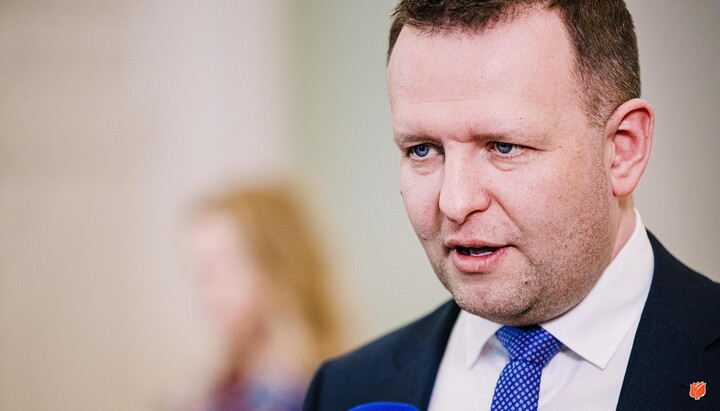
Interior Minister Lauri Läänemets. Photo: Ken Mürk/ERR
Estonia's government demands that the Estonian Orthodox Church of the Moscow Patriarchate (EOC MP) submit amendments to its statutory documents by the beginning of July of this year, indicating a break from the Russian Orthodox Church. This was stated by the Minister of Internal Affairs of Estonia, Lauri Läänemets, according to ERR.EE.
"The Church must realize this security threat to Estonia. Even before the war, threats were coming from the Kremlin with concrete promises of what they would do, and they fulfilled these threats," believes the Minister of Internal Affairs of Estonia.
According to him, the Church requested additional time from the state.
"It is clear that the Church needs to discuss the situation with its parishes, it needs to make an official decision. To do this, as I understood it, Moscow's consent is needed. And ultimately, changes to the statute will be needed because from the very beginning, the necessity of following the word of the Moscow Patriarchate is written in their statute," said Lauri Läänemets.
Bishop of Tartu, Vicar of the Tallinn Diocese Daniel, responds that the EOC MP is ready for even greater autonomy at the statutory level, but a complete break is not as simple as it seems. For an institution like the Church with a two-thousand-year history, Daniel notes, it is important to adhere to canons, and quick decisions, in line with the logic and pace of secular life, are impossible.
"If we are an autonomous part of the Moscow Patriarchate, then we must coordinate our steps with the patriarchate or the patriarchy. But they may have their own vision about this," said the Vicar of the Tallinn Diocese Daniel.
The head of the Estonian Ministry of Internal Affairs stated that amendments to the statute about the actual break from Moscow are expected by the beginning of July 2024.
"By the beginning of July, we expect proposals on how these changes to the statute will look. This is certainly not easy. Because when we talk about direct subordination, the question arises of what to do with the name of the church, because the name of the Church contains an indication of subordination," noted Läänemets.
Changing the name, says Bishop Daniel, is the easiest thing to do in the current situation.
"The current name of our church – I think it was a requirement from the state back in 2002 when we registered our Church. We were ready for our Church to be the Estonian Orthodox Church. It was a requirement of the state to add 'Moscow Patriarchate' to this. If it comes to the name, in this regard, I think no one has a question whether our Church can be called the EOC – yes, of course, we agree," said Bishop Daniel.
As reported, in Estonia, the authorities have stopped leasing premises to the EOC.
Read also
Court takes 17th-century church in Staryi Pochaiv from UOC community
A commercial court overturned a 2018 registrar’s decision and stripped the UOC’s Ternopil Eparchy of ownership of the 17th-century church.
Rada speaker discusses legalization of same-sex marriage in Rivne region
Ruslan Stefanchuk suggested that sponsors of separate bills to legalize same-sex marriage personally make their case to Ukrainians.
SBU told Phanar many UOC bishops would join OCU in 2018, report says
According to a Phanar representative’s account, Ukrainian security services told the Constantinople delegation that many UOC representatives were prepared to attend the OCU’s “Unification Council.” In the end, only two did.
Catholic cardinal visits Ukrainian POWs during trip to Russia
During three days of consultations in Moscow, Cardinal Matteo Zuppi discussed prospects for ending the war in Ukraine.
Ukrainians help restore Serbian Orthodox church in Paris
Orthodox Ukrainians have become regular parishioners of St. Sava Church in Paris and have taken part in its restoration.
Bulgarian Church clergy and laity oppose Phanar head’s visit
More than 2,000 clergy and laity have called for the Ecumenical Patriarch’s visit to be canceled, citing disagreement with his actions and concerns that the visit could legitimize schism.