Church celebrates St. Prince Volodymyr and the Day of Baptism of Rus'
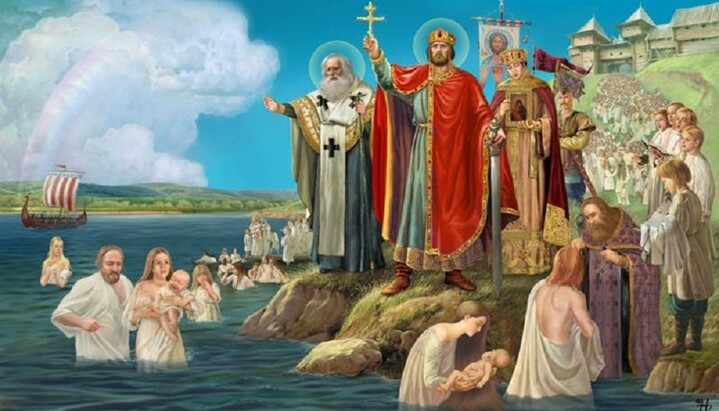
Baptism of Rus' by Prince Volodymyr. Photo: pinterest.com
On July 28, 2024, the Church celebrates the memory of St. Equal-to-the-Apostles Prince Volodymyr and the Day of the Baptism of Rus'.
In the Ukrainian Orthodox Church, by the blessing of the ever-memorable Metropolitan Volodymyr (Sabodan), the memory of St. Andrew the First-Called Apostle, the first disciple of Christ who opened the doors of Orthodoxy to the Eastern Slavs and planted the Cross on the hills of Kyiv, is also celebrated on this day.
Prince Vladimir, the Baptizer of Rus', was born around 960 and was the grandson of St. Equal-to-the-Apostles Princess Olga. Before embracing Christianity, he was a harsh ruler relying on pagan traditions, but his conversion to Christianity completely transformed him.
Prince Volodymyr was baptized in Korsun (Chersonesus) in 988, which is considered the official beginning of the Baptism of Rus'. Returning to Kyiv with Greek clergy, he baptized the residents of the city.
He first invited his twelve sons to be baptized, followed by many boyars. Then, St. Volodymyr announced that all residents of Kyiv, rich and poor, should come to the river on a certain day to receive baptism. On the appointed day, the people of Kyiv gathered on the banks of the Dnieper River, and the prince himself appeared with Christian priests. All the Kyivan residents entered the river, with adults holding infants in their arms. The priests on the shore read prayers, and St. Volodymyr prayed to God, entrusting himself and his people to Him.
This event ushered in the period of baptism of the entire Rus'.
After embracing Christianity, the prince spoke of himself: "Lord! I was like a beast, lived like an animal, but You tamed me. Glory to You, God!" He ceased military campaigns against neighbors and lived peacefully with all nations, only defending the borders from the nomadic Pechenegs. Prince Volodymyr released all his former wives and concubines, entered into a Christian marriage with the Greek princess Anna, completely abolished the death penalty, and did not want to punish even murderers and robbers. But at the request of Greek bishops, concerned about crime in Rus', he reluctantly reinstated the death penalty.
The princely court was open to the poor and needy. The holy prince, who was called the Red Sun during his lifetime, distributed food, clothing, and money to the people, redeemed debtors from bondage, and restored freedom to captives and prisoners.
The great prince was a gifted ruler who not only successfully defended his native land and strengthened its borders but also engaged in the development of education in his principality.
The Great Prince Volodymyr passed away on July 15 (28), 1015, in the village of Berestovo, near Kyiv. He was buried in the Church of the Tithes, which he founded.
Earlier, the UOJ wrote about what Princess Olga did for Rus'.
Read also
Upper Lavra court hearing postponed
The next court hearing in the Upper Lavra case has been scheduled for November 3.
UOC priest blesses ambulances at Kamianske medical center
A UOC priest in Kamianske blessed ambulances for a medical facility and wished its doctors God's help in their work.
Dumenko to German ambassador: Law targeting UOC also applies to other groups
Epifaniy Dumenko sought to defend Ukraine’s law restricting religious organizations during a meeting with the German ambassador.
Activists bused to court hearings in UOC cases, media say
A minibus has been spotted transporting protesters to and from courthouses where UOC cases are being heard.
Firefighters save historic UOC church from fire in Zakarpattia
A fire broke out at a UOC church in the Tiachiv district, damaging the altar and church furnishings.
Volyn Eparchy faithful collect six tons of aid for Sviatohirsk Lavra
Believers in Volyn collected food and warm clothing for people displaced by the war who have found shelter at Sviatohirsk Lavra.