Poturaev's committee: Bill 8371 is discredited
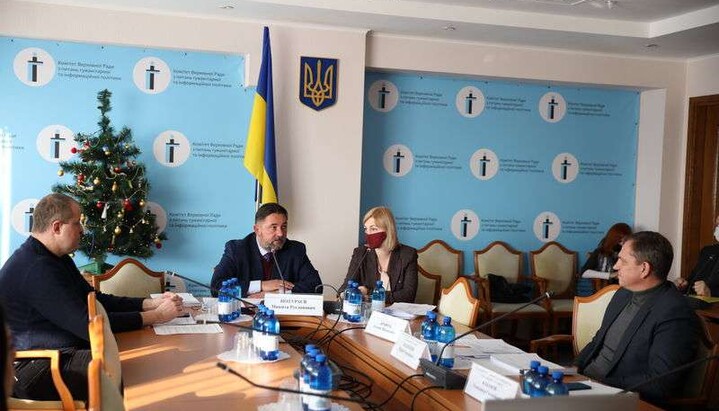
The Committee on Humanitarian and Information Policy. Photo: the Verkhovna Rada of Ukraine
On 1 August, the Verkhovna Rada Committee on Humanitarian and Information Policy said that a whole campaign to discredit the bill was launched against the legislative initiative 8371. The statement was published on the Rada website.
Committee members note that representatives of most factions were ready to support the bill in the first reading but it needed to be finalized and DESS had to improve the law. The Committee on Humanitarian and Information Policy stresses that they did not change the mechanism of banning Ukrainian religious organisations proposed by DESS. With regard to them, DESS should establish the facts of their links with the Russian Orthodox Church.
“The Committee is extremely surprised by the unsubstantiated pseudo-critical remarks that have recently been made to the text of Bill 8371 by various commentators. These statements give the impression that these experts, firstly, have not read the text of the bill for the second reading, and secondly, they are trying to evaluate it from a religious point of view, although, as we have proved, the draft law does not concern religion at all,” the deputies stressed.
According to the deputies, behind this campaign are “lobbyists and agents of influence of one of the Ukrainian churches, regarding which there are preliminary stable reasons to believe that it has hidden ties with the ROC”.
“The committee regards this campaign as a ‘admission of guilt’ on the part of the church, which publicly declares that it has severed its ties with the ROC, but at the same time for some reason – like the devil – fears a bill to ban this criminal organisation and its associated henchmen in Ukraine,” the statement says.
As reported by the UOJ, earlier DESS officials issued a statement saying that Bill 8371 should be finalized so that “it does not become a laughing stock”.
Read also
OCU activist admits breaking into UOC church in Sloviansk
Oleksandr Onyshchenko said that the OCU held its first "service" at the Seraphim Church, which had previously been broken into by forcing the locks and doors.
Archimandrite Ioustinos, longtime keeper of Jacob's Well, dies in Jordan
Archimandrite Ioustinos (Mamallos), the keeper of Jacob's Well in Nablus, has died after a prolonged illness.
Pilgrim group from Kyiv Theological Seminary visits Mount Athos
KTS students are making a pilgrimage to the holy sites of Romania, Greece, Mount Athos and Italy.
UOC cathedral celebrates its patronal feast in Ternopil
The service in the cathedral of the Holy Martyrs Faith, Hope, Love and their mother Sophia was led by Metropolitan Serhii of Ternopil, concelebrated by four hierarchs.
MinCulture marks centenary of Soviet-era reserve at Lavra's Refectory Church
Representatives of the Ministry of Culture presented awards to the Reserve's employees on the occasion of the anniversary at the Refectory Church of the Lavra.
Conference to mark 1700th anniversary of Christianity adoption held in Georgia
In Georgia, representatives of the Church and the state noted the defining role of Christianity in the country's cultural development.