Rivne Eparchy of UOC supports a flashmob against Phanar head’s visit
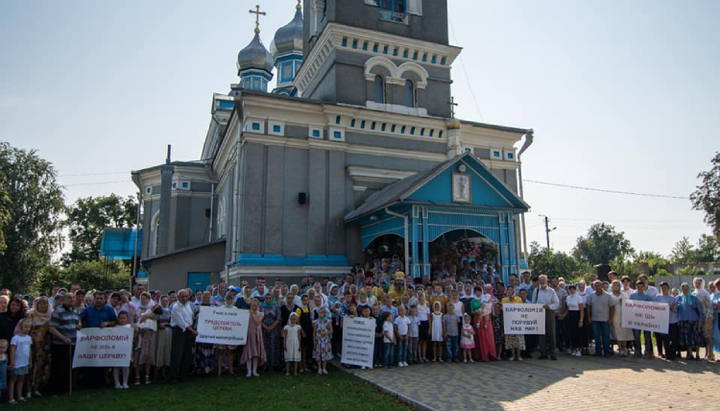
The UOC community in Radyvyliv supported the # STOPVARFOLOMEY flash mob. Photo: facebook.com/ Yaroslav Vozniak
The community of St. Alexander Nevsky Church of the UOC in Radyvyliv of the Rivne Eparchy has joined in a flash mob against the arrival of the Phanar head in Ukraine.
The photo of the flash mob # STOPVARFOLOMEY was posted on the Facebook page by Archpriest Yaroslav Vozniak, the rector of the church in Radyvyliv.
The parishioners of the UOC gathered near their church and took pictures with posters expressing the position of believers regarding the Phanar head’s arrival in Kyiv.
The believers called on Patriarch Bartholomew not to disturb the peace of Ukraine and not to interfere in the Ukrainian Orthodox Church.
“We have our own Primate of the Church, another is not needed,” the community said.
As reported, UOC believers are urged to testify to their faith before the Phanar head.
Read also
Mobilized priest of Volodymyr-Volynsky Eparchy of UOC killed
A funeral service for Fr Andrii Korynchuk, a priest killed in the war, to be held at UOC Resurrection Cathedral in Kovel.
TRC officers draft UOC priest in Chernihiv
TRC officers have detain Archpriest Pavlo Tovstohon of the Christ's Nativity Church.
Patriarch Bartholomew and Shevchuk discuss obstacles to ecumenical unity
The head of the UGCC said that replacing Christian patriotism with the idea of loyalty to a "warring god" is an obstacle to ecumenical dialogue.
Ukraine’s Foreign Ministry plans advocacy visits abroad for UCCRO
Members of the All-Ukrainian Council of Churches and Religious Organizations have planned advocacy visits abroad following a meeting with Ukraine’s deputy foreign minister.
UOC priest detained by recruitment officers in Kyiv sent to training ground
UOC priest Maksym Kostiuchenko, who was detained on his way to a church service in Kyiv, has been sent to a military training ground in Chernihiv Region.
25 tons of humanitarian aid from Volyn reach Sviatohirsk Lavra
Around 25 tons of food donated by believers of the UOC Volyn Eparchy arrived at Sviatohirsk Lavra on October 22.