Fylypovych: God did not create the Church, place for rituals does not matter
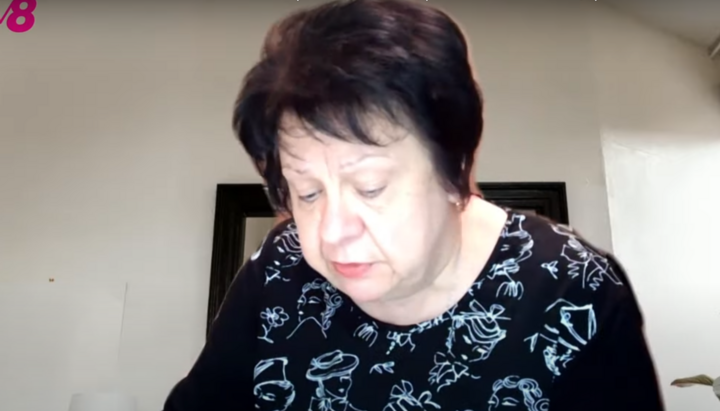
Liudmyla Fylypovych. Photo: Screenshot from TV8 video
A few days ago, the Moldovan TV channel TV8 discussed the law passed by the Ukrainian parliament, the "law banning the UOC". Doctor of Philosophy, professor at the Skovoroda Institute of Philosophy of the National Academy of Sciences of Ukraine, and religious scholar Liudmyla Fylypovych explained on air that no one in Ukraine is persecuted for their faith because Ukraine is a democratic country striving to join the EU, where people's rights and freedoms are guaranteed. According to her, law No. 8371 is not directed against the UOC, although as a result, some communities may end up outside the law. Additionally, the religious expert stated that ultimately, it doesn’t matter which church one attends or where rituals are performed.
"The concept that people are persecuted for their faith in Ukraine, referring to mainland Ukraine under the control of the Ukrainian government, is somewhat fake news," Fylypovych said.
According to her, in Ukraine, they are not persecuting UOC clergy but citizens who have broken the law, and their guilt still needs to be proven. At the same time, she herself admitted that most of the cases opened are related to UOC clergy. The religious scholar did not provide any information on proven guilt.
Fylypovych repeatedly underscored that Ukraine is a democratic, civilized country where people's rights and freedoms are guaranteed.
"We are a civilized country. Ukraine is aiming to join the European Union and considers itself part of European civilization and the EU, where people's rights are respected, and freedoms are guaranteed. If these freedoms are violated, you have the opportunity to go to court, and the court will side with you and protect your rights," the philosopher assured.
When asked by the host what would happen to those UOC believers who do not wish to join the OCU, Fylypovych said they would most likely be deprived of some rights. In her opinion, if they don't understand the necessity of changing their canonical allegiance, they will continue to exist in the status of a non-canonical Orthodox church, as has been the case with the UOC-Kyiv Patriarchate for the past thirty years.
"Yes, they will be deprived of rights to the effect that, for example, they may not be able to rent certain spaces as a legal entity, there may be restrictions on opening collective bank accounts, or something like that. But this does not mean they will be persecuted," the expert said.
However, according to her, none of this is particularly significant, as "the church is a human invention."
"In the end, what do we believe in? In the church or in God? If we believe in God, then it doesn’t matter much in which church the rituals take place, because God did not establish the church. God gave us the commandments of faith, hope, and love. The church, as they say, is a human invention," concluded the Ukrainian religious scholar.
As the UOJ previously reported, Liudmyla Fylypovych stated that the adoption of bill No. 8371 in its latest edition would have negative consequences for Ukraine's image in the world. Earlier, the religious scholar criticized law 8371. In the legislative initiative, Fylypovych saw echoes of totalitarianism and warned against its adoption.
Read also
Met. Meletiy consecrates house of worship for UOC community in Dankivtsi
Members of the persecuted UOC Intercession parish in Dankivtsi have converted a house into a place for communal prayer and worship services.
OCU eparchy sells church center site to developer for housing
The OCU’s Volyn Eparchy sold land intended for a spiritual center to a private developer planning to build townhouses and residential buildings.
SBU names UOC priest’s wife a suspect in Cherkasy region
The SBU accused Matushka Kateryna Prykotenko of “spreading enemy propaganda” through correspondence with parishioners.
UGCC cleric calls Russian Orthodox literature dangerous for clergy
While examining the causes of divisions within the UGCC, Yustyn Boiko concluded that Russian Orthodox literature had influenced Greek Catholic clergy.
UOC will play major role in achieving peace, says Vadym Novynskyi
UOC Protodeacon Vadym Novynskyi believes the Church will help bring about reconciliation within Ukrainian society after the war ends.
Catholic media outraged by forcible conscription of Uniate cleric
The Vatican’s Apostolic Nunciature has demanded the return of a forcibly mobilized Greek Catholic cleric.