U.S. nuclear scientist confirms the Turin Shroud is 2000 years old
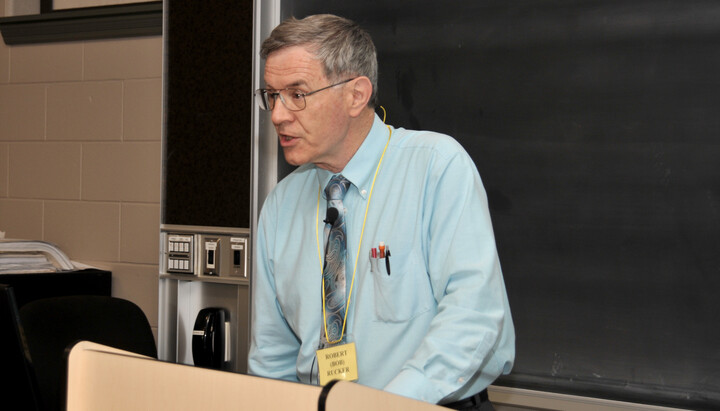
Robert Rucker. Photo: shroud.com
American scientist Robert A. Rucker, a nuclear engineer with more than 38 years of experience in the nuclear industry and a respected researcher in the field of nuclear physics and analysis, has stated that, according to his analysis, the Turin Shroud is approximately 2000 years old.
The scientific confirmation of the Shroud's origin in the first century AD came from nuclear analytical calculations performed by Bob Rucker and his team.
The results of Rucker's research were published in an article titled “Does Carbon Dating Disprove the Shroud's Authenticity?”
These calculations were made using MCNP (Monte Carlo N-Particle) software, which allows for modeling the interaction of particles with materials, including fabrics like the Turin Shroud.
Using this tool, Rucker was able to analyze the Shroud's radiocarbon data, challenging the previous dating conclusions made in 1988.
The 1988 studies claimed that the Shroud dated to the period 1260–1380 AD, leading to theories of its medieval origin.
However, Bob Rucker argues that these findings were incorrect because they did not account for radiation emitted by Christ's body at the moment of resurrection.
According to his hypothesis, neutrons released at this moment could have altered the carbon-14 levels in the Shroud's material, thereby skewing the radiocarbon dating results.
“We have proven that the dating of the Turin Shroud should correspond to the first century AD,” Rucker states, emphasizing the importance of considering the unique conditions under which possible changes in carbon isotopes occurred.
Additionally, Rucker explains that his research goes beyond dating and touches on broader aspects of the Shroud's nature, such as the analysis of the blood and the image itself.
According to him, the image on the Shroud “remains a mystery,” as no one has yet been able to fully explain how the image was formed.
Nonetheless, his group has already presented research results confirming the presence of real human blood on the Shroud, which is also a significant point in favor of its authenticity.
“The Turin Shroud is the second most valuable object for humanity after the Bible itself,” Rucker believes.
The Shroud is currently kept in the Chapel of the Holy Shroud next to the Cathedral of Saint John the Baptist in Turin, Italy, where it continues to be a pilgrimage hub for millions of believers.
As previously reported, a 3D image of Christ was created in Italy based on the Turin Shroud.
Read also
SBU told Phanar many UOC bishops would join OCU in 2018, report says
According to a Phanar representative’s account, Ukrainian security services told the Constantinople delegation that many UOC representatives were prepared to attend the OCU’s “Unification Council.” In the end, only two did.
Catholic cardinal visits Ukrainian POWs during trip to Russia
During three days of consultations in Moscow, Cardinal Matteo Zuppi discussed prospects for ending the war in Ukraine.
Ukrainians help restore Serbian Orthodox church in Paris
Orthodox Ukrainians have become regular parishioners of St. Sava Church in Paris and have taken part in its restoration.
Bulgarian Church clergy and laity oppose Phanar head’s visit
More than 2,000 clergy and laity have called for the Ecumenical Patriarch’s visit to be canceled, citing disagreement with his actions and concerns that the visit could legitimize schism.
Unknown intruders break down doors at two UOC churches in Sloviansk
Archbishop Paisiy said OCU activists are suspected of breaking into the churches in Sloviansk, and police have launched an investigation.
Sviatohirsk Lavra prays for murdered monk on 40th day after death
The brethren of the Sviatohirsk Lavra held a memorial service for murdered Monk Varsonofiy, calling on the faithful to pray for the newly departed monk.