Expert explains why countries are withdrawing from Istanbul Convention
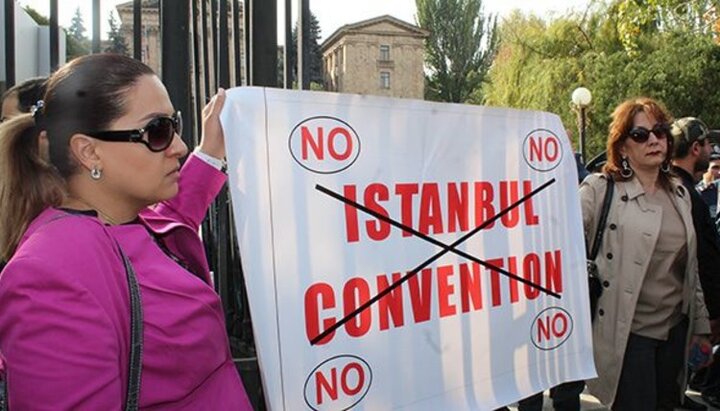
Protests against the Istanbul Convention. Photo: kavkaz-uzel.eu
Oleg Denisov, head of the NGO “Public Advocacy” and the author of the petition to reject the promotion of controversial gender theories in Ukraine, explained why countries, one after another, refuse to ratify the Council of Europe Convention on the Prevention of Violence against Women and Domestic Violence (Istanbul Convention).
In the blog “I am a Correspondent”, the Ukrainian human rights activist noted that at first glance, the convention is read as a legal act aimed at protecting women from violence, and no sane person can object to this. However, "for some reason, a number of states, such as Bulgaria, Hungary, the Czech Republic, Latvia, Lithuania, Liechtenstein, Great Britain, have not ratified the Istanbul Convention, although all of the listed countries signed this convention at the stage of its adoption in 2011".
Moreover, the lawyer added, Turkey, which was the first to sign this document, withdrew from the agreement in 2021, explaining that “the original goal of protecting women's rights was seized by a group of people trying to normalize homosexuality, which is incompatible with the social and family values of Turkey". The Polish authorities also announced their desire to withdraw from the convention, calling it "harmful".
“Has the problem of violence against women disappeared in 10 years, or, perhaps, the text of the convention was misread by the diplomats of the foreign ministries of all these countries – ‘didn’t read it fully’?” Paradoxical as it may sound, the second option is correct, since when this act was signed, completely different tasks followed directly from its text than those which actually are being promoted by supporters of imposing the concept of multiple sexes or, in other words, gender identity, on the world,” explained Oleg Denisov.
According to him, “in reality, the Istanbul Convention is an example of a legal act, in order to understand the essence of which it is necessary to take into account the current tendencies of the erosion of law and the advancement under the cover of certain values of ‘equality’ declared in international acts and others of a completely different content, which becomes clear only after some stages of the actual implementation of these conventions by foundations and non-governmental organizations that come to the state with their educational programmes, reforms and bylaws detailing the international convention in a completely different meaningful format."
In fact, the human rights activist emphasized, it is about imposing a new "correct" system of values, worldview and attitudes, and behind the good wording of the text of the convention "there is a specific mechanism of social engineering, the actual value reprogramming of society".
Oleg Denisov also spoke about the consequences of the possible ratification of the Istanbul Convention by Ukraine.
As reported, the UOC laity urge to support an electronic petition on the website of the President of Ukraine "On refusal to promote gender theories that contradict traditional family values, in particular by refusing to sign and (or) ratify the Istanbul Convention and ensure public control over the Biarritz Partnership".
Read also
SBU told Phanar many UOC bishops would join OCU in 2018, report says
According to a Phanar representative’s account, Ukrainian security services told the Constantinople delegation that many UOC representatives were prepared to attend the OCU’s “Unification Council.” In the end, only two did.
Catholic cardinal visits Ukrainian POWs during trip to Russia
During three days of consultations in Moscow, Cardinal Matteo Zuppi discussed prospects for ending the war in Ukraine.
Ukrainians help restore Serbian Orthodox church in Paris
Orthodox Ukrainians have become regular parishioners of St. Sava Church in Paris and have taken part in its restoration.
Bulgarian Church clergy and laity oppose Phanar head’s visit
More than 2,000 clergy and laity have called for the Ecumenical Patriarch’s visit to be canceled, citing disagreement with his actions and concerns that the visit could legitimize schism.
Unknown intruders break down doors at two UOC churches in Sloviansk
Archbishop Paisiy said OCU activists are suspected of breaking into the churches in Sloviansk, and police have launched an investigation.
Sviatohirsk Lavra prays for murdered monk on 40th day after death
The brethren of the Sviatohirsk Lavra held a memorial service for murdered Monk Varsonofiy, calling on the faithful to pray for the newly departed monk.