The Church commemorates the Apostle Andrew the First-Called
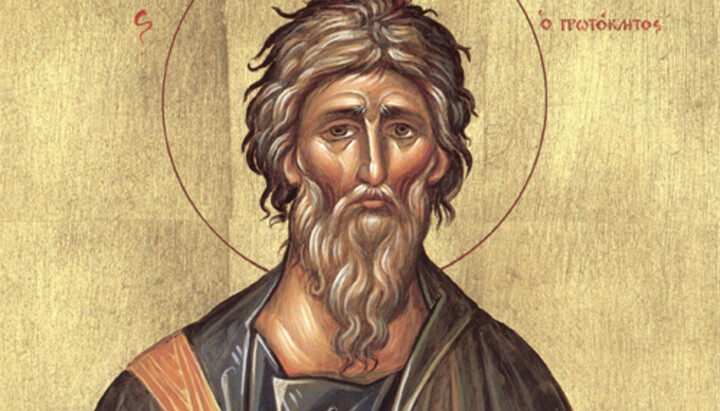
The Apostle Andrew. Photo: Poltavshchyna
On December 13, the Orthodox Church celebrates the memory of the Holy Apostle Andrew the First-Called, who brought the message of Orthodoxy to Kyiv.
The Holy Apostle Andrew the First-Called was the first of the apostles to follow Christ, later bringing his brother, the Apostle Peter, to Him.
In his youth, the future apostle, a native of Bethsaida, devoted himself wholeheartedly to God. He remained unmarried and worked as a fisherman with his brother. When the voice of the holy prophet, Forerunner, and Baptist of the Lord, John, resounded across Israel, Andrew became his closest disciple. Saint John the Baptist himself directed two of his disciples, the future apostles Andrew the First-Called and John the Theologian, to Christ, pointing out that He was the Lamb of God.
After the descent of the Holy Spirit upon the apostles, Saint Andrew traveled to eastern lands to preach the Word of God. He journeyed through Asia Minor, Thrace, and Macedonia, reached the Danube, traveled along the shores of the Black Sea, passed through Crimea, and ascended the Dnipro River to the place where the city of Kyiv now stands. Here, he stayed overnight on the Kyiv hills. In the morning, he told his disciples, "Do you see these hills? On these hills, the grace of God will shine; there will be a great city, and God will raise many churches."
The apostle climbed the hills, blessed them, and erected a cross. After praying, he continued up the Dnipro and reached the settlements of the Slavs, where Novgorod was founded. From there, he traveled through the lands of the Varangians to Rome to preach and then returned to Thrace, where he established a Christian Church in the small settlement of Byzantium, which would later become the mighty city of Constantinople.
On his journey, the First-Called Apostle endured many hardships and sufferings at the hands of pagans: he was expelled from cities and beaten. In Sinope, he was stoned but remained unharmed, continuing to tirelessly preach the message of the Savior.
Through the prayers of the apostle, the Lord performed miracles. Christian Churches were established through his labors, and he ordained bishops and clergy for them.
The final city where the First-Called Apostle arrived and where he was destined to meet a martyr’s death was the city of Patras. In this place, the Lord worked many miracles through His disciple: the sick were healed, and the blind received sight. By the apostle's prayers, Sosios, a prominent citizen suffering from a severe illness, was healed; Maximilla, the wife of the ruler of Patras, and his brother Stratocles were also cured through the apostle's laying of hands. The miracles performed by the apostle and his fervent preaching brought the true faith to nearly all the citizens of Patras.
Few pagans remained in Patras, among them the city’s ruler, Aegeates. The Apostle Andrew repeatedly addressed him with words of the Gospel. However, even the apostle's miracles could not convince Aegeates. With love and humility, the saint appealed to his soul, striving to reveal the Christian mystery of eternal life and the miraculous power of the Holy Cross of the Lord. Enraged, Aegeates ordered Andrew to be crucified. The pagan believed he could discredit the apostle’s message by condemning him to death on the cross he so glorified. With joy, Saint Andrew accepted the ruler’s decree and, praying to the Lord, ascended to his place of execution. To prolong the apostle's suffering, Aegeates ordered that his hands and feet not be nailed but tied to the cross. For two days, the apostle preached to the gathered crowd from the cross. The people, moved with compassion, demanded that the saint be released. Fearing public unrest, Aegeates ordered the execution to stop. But Saint Andrew prayed that the Lord would grant him the honor of dying on the cross. When the soldiers tried to remove him from the cross, their hands would not obey them. The crucified apostle, giving thanks to God, said, "Lord Jesus Christ, receive my spirit."
Then a bright light of Divine glory illuminated the cross and the martyr crucified upon it. When the light faded, the Holy Apostle Andrew the First-Called had already given his soul to the Lord. Maximilla, the ruler’s wife, removed the apostle’s body from the cross and buried him with honor.
Several centuries later, during the reign of Emperor Constantine the Great, the relics of Saint Andrew the Apostle were solemnly transferred to Constantinople and placed in the Church of the Holy Apostles alongside the relics of the Evangelist Luke and the Apostle Timothy.
Read also
Volodymyr-Volynskyi Eparchy marks 30 years since restoration
The Pantanassa Icon and relics of Prince Volodymyr have arrived in Kovel and will visit churches across the Volodymyr-Volynskyi Eparchy to mark the 30th anniversary of the restoration of the episcopal see.
Bukovyna faithful bring humanitarian aid to Kherson region residents
The UOC’s Chernivtsi Eparchy delivered food to Holy Spirit Cathedral in Kherson.
Ukraine must have its own faith: Poroshenko's party lays out peace terms
Poroshenko’s party European Solidarity described church policy as a matter of national sovereignty and said there can be no compromises in this area.
432 UOC churches damaged in Ukraine during war, report says
According to the Religion on Fire project, 807 religious buildings in Ukraine have been damaged or destroyed as a result of hostilities.
DESS official gives number of clergy exempt from mobilization in Ukraine
A DESS representative said the actual number of clergy exempt from mobilization is significantly lower than the number of religious organizations designated as critical.
Cabinet keeps gas prices unchanged for religious organizations
The Cabinet has fixed gas prices for religious organizations through the end of the 2026–2027 heating season.