Expert explains why the Vatican did not announce meeting with OCU's head
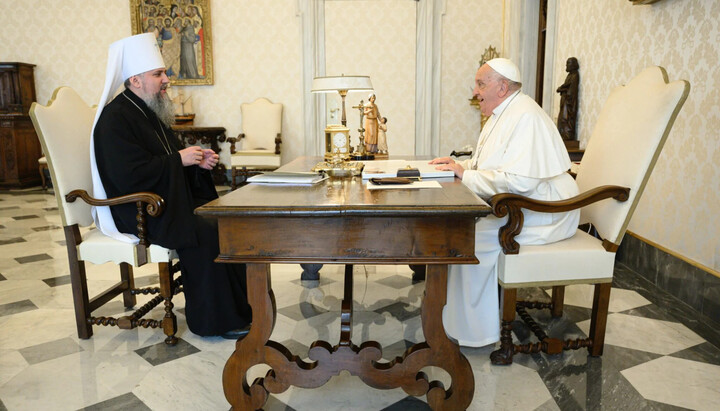
The Pope. Photo: OCU
The Vatican did not announce the meeting between OCU leader Epifaniy Dumenko and Pope Francis because the visit was unofficial, according to Ukrainian Vatican researcher Pavlo Smytsniuk. His comments were published by Holos Ameryky.
He pointed out that on Friday, there was no mention of the meeting in the Holy See’s press bulletin or in the news from the Ukrainian section of Vatican Radio.
"For the Vatican or the Catholic Church, there is no formal procedure for 'recognizing' other churches or church communities. Usually, everything starts with unofficial meetings, correspondence, agreements to participate in joint events, and so on. That’s why today’s meeting is very significant," Smytsniuk explained.
He also noted that the Vatican had previously shown little openness to engaging with Orthodox churches that "broke away from Moscow’s control." However, with the recognition of the OCU by the Patriarchate of Constantinople, which maintains good relations with the Pope, the situation is changing.
"But since the majority of Orthodox Churches have not yet recognized the OCU, the Vatican must act cautiously to avoid being drawn into intra-Orthodox conflicts," the researcher added.
Smytsniuk emphasized that since the start of Russian aggression, the Holy See has sought to act as a mediator and has been actively involved in efforts to secure the return of kidnapped Ukrainian children and prisoners from Russia.
In the expert's view, this mediating role compels the Vatican to exercise caution in announcing such meetings. On the one hand, the Pope agrees to direct dialogue with the OCU, understanding that "if he wants to play a role in ending Russian aggression against Ukraine," he must establish relations with Dumenko’s organization. On the other hand, Smytsniuk noted, the dialogue with the OCU must be conducted in a way that avoids incurring the wrath of Moscow and the Russian Orthodox Church.
As previously reported by the UOJ, Dumenko discussed the law banning the UOC with the head of the Papal Council during his visit to the Vatican.
Read also
Khust Eparchy honors memory of St. Job of Uholka
A Liturgy is served in Mala Uholka, a birthplace of St. Job of Uholka, on the saint's feast day.
UOC parish in Cologne donates ultrasound machine to Kharkiv region hospital
In Cologne, UOC believers raised funds for an ultrasound machine for the Kehychivka district hospital in the Kharkiv region.
Shevchuk tells Pope Leo of Ukraine's preparations for "another harsh winter"
The head of the UGCC expressed "special gratitude" to the Pope for his phone calls with Putin and Zelensky.
Berlin hierarch comments on Phanar document published by UOJ-USA
Metropolitan Mark called the information about the 2018 "Unification Council" alarming if confirmed, and expressed hope that Patriarch Bartholomew will reconsider his position.
UOC marks Synaxis of All Saints of Volyn Land at Lutsk cathedral
Metropolitan Serhiy of Ternopil and Kremenets led the Liturgy on the feast day of the Lutsk cathedral of All Saints of the Volyn Land.
SBU detains OCU cleric who organized draft evader's escape for money
In Transcarpathia, law enforcement officers detained a clergyman of the OCU who arranged for a draft evader to be smuggled into Slovakia for $15,000.