UOC Primate discusses how to approach wealth
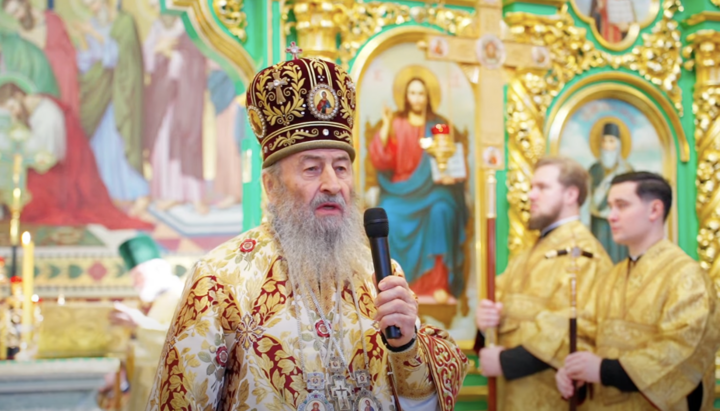
His Beatitude Metropolitan Onuphry. Photo: UOC
"All earthly things are given to us to achieve eternity," said His Beatitude Metropolitan Onuphry of Kyiv and All Ukraine during his sermon on the 25th Sunday after Pentecost, according to the UOC's Information and Education Department.
His Beatitude highlighted the Gospel passage about the rich young man (Luke 18:18–27), which teaches that wealth should help people attain eternal salvation.
"People relate to wealth in different ways. Some accept it as a gift from God and manage it wisely – using it for their needs, giving to the needy, and offering alms. Others turn wealth into an idol. Such people torment themselves and others. They worship wealth, strive to increase it, and are stingy in sharing it because for them, wealth is an idol – they serve wealth. This attitude toward earthly goods is unworthy. In such cases, wealth becomes an obstacle to a person’s salvation," said His Beatitude.
"If a person masters their wealth, and not the other way around, then they can use earthly goods to gain eternal treasures in Heaven. People approach wealth differently: some use it for good by helping those in need, while others worship wealth, making it their idol, which then becomes a hindrance to their salvation," emphasized His Beatitude Metropolitan Onuphry.
According to the Archbishop, earthly goods should help in accumulating eternal treasures. However, there are instances when wealth becomes an obstacle to spiritual growth, as seen in the example of the holy apostles who left everything to follow Christ.
"A person can be wealthy and unattached to their wealth, or they can be modest or poor yet attached to something earthly. Such a person is like a bird entangled in a net and unable to fly. A person should not be attached to earthly things. Earthly possessions are given to us to help us achieve the eternal, but they must not become objects of worship," stressed the Primate.
His Beatitude Metropolitan Onuphry also drew attention to the final part of this story, specifically the Savior’s response to those who asked Him who can be saved. The Lord said, "What is impossible for man is possible for God" (Luke 18:27). "Here the Lord says that the gift of salvation and the gift of eternal life cannot be earned or deserved from God. We cannot make God our debtor," the Metropolitan emphasized.
According to His Beatitude, even those who achieved high levels of spiritual perfection prayed, saying, "Lord, have mercy on me, grant me eternal life."
In conclusion, the Archbishop called on all believers to strive for spiritual perfection and pray for the gift of eternal life: "May the Lord help us live so that nothing earthly surpasses God in importance, and so that we always strive for the great gift of eternal salvation."
As previously reported by the UOC's press service, His Beatitude led the Divine Liturgy at the Kyiv-Pechersk Lavra.
Read also
OCU cleric's church preference poll delivers unexpected results
When an OCU cleric from Rivne asked Ukrainians which Church they preferred, most Threads users who responded chose the UOC.
Reports to SBU of weapons in UOC churches were always false, Novynskyi says
The protodeacon said that under Maliuk, inspections began to be accompanied by public accusations against the Church without evidence.
Culture Ministry pledges to speed up seizure of Kyiv-Pechersk Lavra from UOC
Culture Minister Tetiana Berezhna has pledged to personally attend a court hearing in the Kyiv-Pechersk Lavra case.
Kamianske Eparchy honors Dnipro Icon of the Mother of God for first time
A festive service was held at a cathedral in Kamianske, where the Dnipro Icon of the Mother of God was brought out for veneration by the faithful for the first time.
Kyiv conscription officers abduct UOC priest
TRC officers reportedly abducted Maksym Kostiuchenko, a cleric of a UOC church in the Ukrainian capital.
Court grants DESS lawsuit to dissolve UOC’s Rovenky Eparchy
The appeals court partially granted the DESS lawsuit seeking to dissolve the Rovenky Eparchy but rejected the request to seize its property, citing a gap in Ukrainian legislation.