Passions over the Lavra show
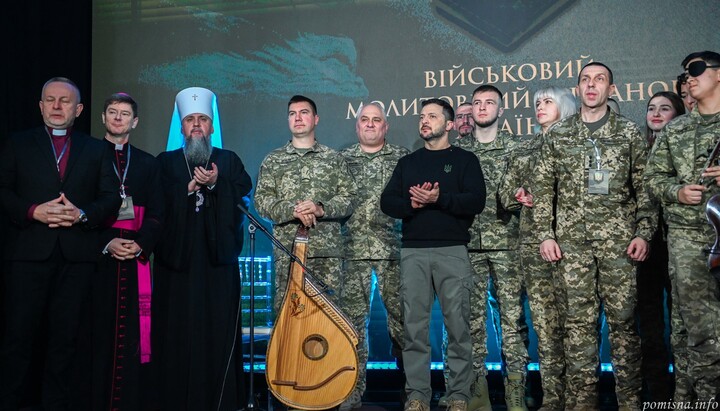
A military prayer lunch at the Lavra. Photo: President’s press service
Unexpectedly, the filming of a culinary show in the Refectory Church of the Lavra sparked a major scandal in Ukrainian society. People are outraged that "food on display" against a backdrop of icons is not exactly what they expect to see in churches. The show's organizers (authorities and creators) have already initiated crisis management and issued "urgent statements." Naturally, the Kremlin and the UOC are to blame as the ususal culprits (who else?).
This was predictable.
What was not predictable, however, was criticism from other denominations. For example, one of the OCU’s media spokesmen, Dediukhin, called the show’s curators from the Ministry of Culture "demons" and wrote about yet "another desecration of a holy site." But the farthest critique came from Catholic Bishop Vitalii Kryvytskyi in Ukraine. He believes that using churches for non-sacred purposes is a revival of communism, which "extends its tentacles into the present."
"Now the descendants of those communists, lacking counterarguments, simply say: 'This is what our legislation allows' or 'What’s so bad about it?'" Kryvytskyi writes, adding that events like the culinary show offend the religious feelings of Ukrainians. "The problem is that just like the Marxists of the 1920s, the Marxists of the 2020s are unable to understand this. Or perhaps they understand it all too well… which is why they create the relevant legislation," the bishop said.
One might applaud him for his strong words. However, it is worth recalling that just a week earlier, Kryvytskyi, alongside rabbis and Muslim imams, participated in a similar, if not worse, event in the same Refectory Church – a "military prayer breakfast", dedicated to Armed Forces Day. At that time, the Refectory was filled with tables of food, and large monitors blocked part of the church’s icons and frescoes with President Zelensky’s broadcast. What a great opportunity it was to tell the President face-to-face about "modern-day Marxists." Kryvytskyi could have joined forces with Epifaniy Dumenko and firmly demanded that Zelensky change the "wrong legislation." But no – at that time, Kryvytskyi had no complaints about Ukraine’s laws. Nor did he have objections to the law banning the UOC, which he publicly supported during his earlier interactions with Zelensky.
Skilfully riding waves of public sentiment and hype is a trait of politicians. They always strive to be "both smart and attractive." Religious leaders, however, are better off orienting themselves toward something else.
Read also
Ternopil post on Feast of Intercession: Has calendar reformn failed?
A significant number of believers have rejected the new church calendar introduced by the OCU and UGCC with government support.
Shoulder straps or a cassock: who writes the script for UOC "fighters"?
Everything indicates that both Veliar and Pshenychny are ordinary performers of someone else's script. There is only one question – does the scriptwriter wear shoulder straps or a cassock?
Why is it legal to kill a person before birth but not after?
Children are the most privileged members of society. Yet that same society officially permits children to be killed – and on a massive scale.
Honoring the Bolsheviks’ successors at Kyiv Lavra
It was under the Reserve that the relics of the saints were desecrated, Lavra churches were turned into an atheism museum, and toilets were installed in sanctuaries.
"Degenerates" and "stupid animals": anti-UOC activists turn on children
Future historians will wonder how a vast country’s information agenda could have been shaped for so long by people so petty, vicious, and utterly contemptible.
Zelensky sees murder of Polish priest but not of Sviatohirsk monk
Why does Zelensky react so emotionally and swiftly to the murder of a Catholic cleric while remaining completely silent about the murder of an Orthodox monk?