Orthodox and Jews: Who’s at home and who’s a guest
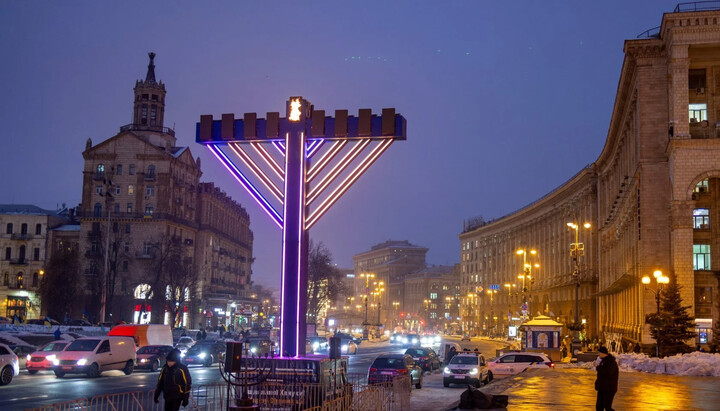
Menorah on Maidan. Photo: Focus
Chilly’s post is being widely discussed on social media, and Israel has even called on Ukraine to act "decisively against those inciting hatred and breaking the law," including on social media.
A centralized anti-crisis PR campaign is being rolled out across various platforms, showcasing the arguments used in this discussion. For example, a segment on the TV channel "1+1" featured interviews with several public figures outraged by Chilly’s post.
MP Vasylenko-Smahliuk stated that the Constitution guarantees everyone freedom of religion and the right to perform religious rituals. Expert Ihor Koshil argued that Ukrainians dissatisfied with menorahs are anti-Semites because "they are not ready to accept people who are different." Ukraine's Chief Rabbi Moshe Reuven Azman, speaking bluntly in Russian, claimed that anyone opposing the menorah in central Kyiv is "working for Russian propaganda."
Why are we writing about this? After all, Jews, like any other religious group, have the right to express their religious feelings as they see fit. However, it’s interesting to draw a parallel with the situation surrounding the Ukrainian Orthodox Church (UOC).
Imagine for a moment that the president announced the need for spiritual independence for Ukraine’s Jews (perhaps because Russia’s Chief Rabbi meets with Putin and doesn’t condemn the "special military operation"). Imagine certain individuals began re-registering Jewish communities under the authority of other religious groups, storming synagogues, and spraying gas, breaking arms, legs, and jaws of Jews defending their sanctuaries. And instead of defending them, the authorities adopted a law banning Jews in Ukraine. Can you imagine that?
Unlikely. Such a scenario in Ukraine is impossible. Why is that?
Why does MP Vasylenko-Smahliuk, a Jewish woman, invoke the Constitution in defense of the menorah on Maidan but forgets about the Constitution when voting to ban the UOC? Why do journalists on "1+1," when commenting on the persecution of Orthodox Christians, not say that society "is not ready to accept those who are different," and instead encourage the harassment? Why don’t they point out that the persecution of the UOC benefits Russian propaganda?
There is nothing wrong with the authorities protecting and supporting Jews and ensuring they feel at home in Ukraine. The problem is that Orthodox Ukrainians are being made to feel as though they are merely guests in their own country.
Read also
Ternopil post on Feast of Intercession: Has calendar reformn failed?
A significant number of believers have rejected the new church calendar introduced by the OCU and UGCC with government support.
Shoulder straps or a cassock: who writes the script for UOC "fighters"?
Everything indicates that both Veliar and Pshenychny are ordinary performers of someone else's script. There is only one question – does the scriptwriter wear shoulder straps or a cassock?
Why is it legal to kill a person before birth but not after?
Children are the most privileged members of society. Yet that same society officially permits children to be killed – and on a massive scale.
Honoring the Bolsheviks’ successors at Kyiv Lavra
It was under the Reserve that the relics of the saints were desecrated, Lavra churches were turned into an atheism museum, and toilets were installed in sanctuaries.
"Degenerates" and "stupid animals": anti-UOC activists turn on children
Future historians will wonder how a vast country’s information agenda could have been shaped for so long by people so petty, vicious, and utterly contemptible.
Zelensky sees murder of Polish priest but not of Sviatohirsk monk
Why does Zelensky react so emotionally and swiftly to the murder of a Catholic cleric while remaining completely silent about the murder of an Orthodox monk?