UN: National security cannot be a ground for violating believers’ rights
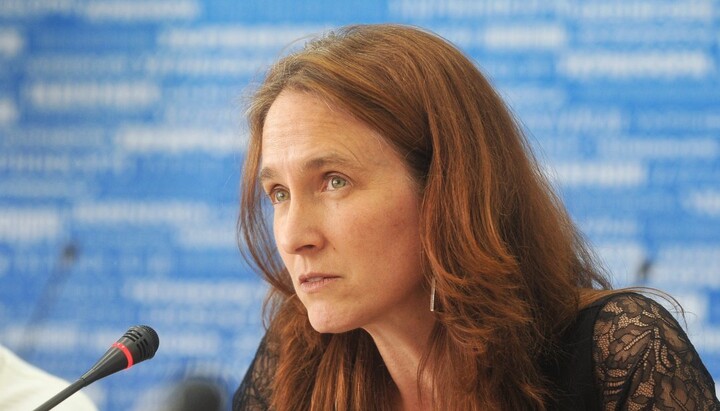
Deputy Head of the UN Human Rights Monitoring Mission in Ukraine, Noelle Calhoun. Photo: Ukrinform
At the press conference "Freedom of Conscience in Ukraine: Its Enemies and Defenders" organized by the State Service for Ethnopolitics and Freedom of Conscience (DESS), Noelle Calhoun, Deputy Head of the UN Human Rights Monitoring Mission in Ukraine, expressed deep concern about potential restrictions on religious freedoms in Ukraine due to new legislation. She emphasized that international standards set a high threshold for such restrictions and that national security cannot serve as justification for violating believers’ rights.
The UN representative stressed that the latest report by the High Commissioner examined the new religious law, No. 3894, solely through the lens of international law, which strictly governs issues of religious freedom.
"International standards set a high threshold for imposing restrictions on freedom of religion. These restrictions must serve a legitimate purpose, such as protecting the rights and freedoms of others. While states can cite national security as a basis for restricting other rights, such as freedom of expression, national security is not a valid basis for restricting freedom of religion under international and European law," Calhoun emphasized.
She noted that the right to freedom of religion is of higher priority than other rights.
"When a state restricts freedom of religion, it bears the burden of proving that the imposed restrictions are necessary," Calhoun said. "Additionally, these restrictions must be proportional. When legislation impacts religious organizations, the state must convincingly demonstrate that less restrictive measures would be insufficient."
Calhoun also highlighted that when analyzing legislation from the perspective of international human rights law, experts closely scrutinize terminology.
"Mr. Yelensky has mentioned the term 'Russian World'… Experts in Geneva are concerned that the law contains broad language that could affect freedom," Calhoun said.
She added that efforts are currently underway to clarify some of these terms.
"The most important question is how this law will impact human rights. Much depends on its future application. We aim to cooperate with you and religious organizations in the coming months as the Cabinet of Ministers develops subordinate acts for the law’s implementation, to continue supporting Ukraine and preserving its valuable tradition of protecting religious rights," concluded the human rights advocate.
Noelle Calhoun, Deputy Head of the UN Human Rights Monitoring Mission in Ukraine, has worked for twenty years with the UN High Commissioner for Refugees in Ukraine, as well as in New York, Geneva, Iraq, Jordan, and Kenya. She holds a PhD in Political Science from Harvard University.
As the UOJ previously reported, Ukraine failed to justify the necessity and proportionality of measures aimed at dissolving religious organizations, including the Ukrainian Orthodox Church. This was stated in the report by the Office of the UN High Commissioner for Human Rights (OHCHR) on the situation in Ukraine from September to November 2024.
Read also
Khust Eparchy honors memory of St. Job of Uholka
A Liturgy is served in Mala Uholka, a birthplace of St. Job of Uholka, on the saint's feast day.
UOC parish in Cologne donates ultrasound machine to Kharkiv region hospital
In Cologne, UOC believers raised funds for an ultrasound machine for the Kehychivka district hospital in the Kharkiv region.
Shevchuk tells Pope Leo of Ukraine's preparations for "another harsh winter"
The head of the UGCC expressed "special gratitude" to the Pope for his phone calls with Putin and Zelensky.
Berlin hierarch comments on Phanar document published by UOJ-USA
Metropolitan Mark called the information about the 2018 "Unification Council" alarming if confirmed, and expressed hope that Patriarch Bartholomew will reconsider his position.
UOC marks Synaxis of All Saints of Volyn Land at Lutsk cathedral
Metropolitan Serhiy of Ternopil and Kremenets led the Liturgy on the feast day of the Lutsk cathedral of All Saints of the Volyn Land.
SBU detains OCU cleric who organized draft evader's escape for money
In Transcarpathia, law enforcement officers detained a clergyman of the OCU who arranged for a draft evader to be smuggled into Slovakia for $15,000.